

The Post-Test Limbo
What to Do Between the Test and the Score
{{first_name | みんな}}さん、こんにちは ☕
It's Tuesday. The test was Sunday. You open your SRS app for the first time since Friday, and there are 412 reviews waiting.
You stare at the screen for a second. Then you close the app and put the phone face-down on the table.
We've put the phone face-down too. We know exactly what that feels like — not tired, not lazy, just... flat. The thing you built your whole spring around is over, and instead of relief you got a strange, quiet emptiness. And the score doesn't come for weeks.
That feeling has a name. And it is not a sign that you're done.
If this is the email you needed the week after a big test, it's the email someone you know needs too. Subscribe or share →
You're Not Under-Motivated. You're Under-Anchored.
Here's the thing almost nobody tells you about the weeks after a test: the problem isn't your motivation. It's your architecture.
For the last six months, one deadline organized everything. It told you what to study Tuesday, why you were doing Anki on the train, what the daily 30 minutes was for. Then Sunday came, and the deadline vanished.
Your brain didn't lose its motivation. It lost its anchor. And it doesn't yet know what to organize around instead.
That's the whole slump, in one sentence. Not "I stopped caring." More like: the scaffolding came down and nothing replaced it, so the daily habit is just floating there, load-bearing on a beam that no longer exists.
Most learners drift away from Japanese in exactly this window. Not because they failed. Because nobody told them the limbo was a thing, or what to do inside it.
The ones who don't drift do four small things in the first two weeks. None of them require new content. None of them cost money. And the most important one takes 20 minutes a week — not two hours a day.
Quick note before we go further: you did not have to sit the JLPT for any of this to apply to you. Any goal that ran your calendar and then ended — a test, a deadline, a challenge you set yourself — leaves the same hole. If you've ever finished a big thing and felt weirdly empty after, this issue is for you too.
The Empty Feeling Has a Name (and It's Documented)
Let's talk about the part that stings the most. Not the "I think I failed" version — we'll get there. The other one.
You walked out thinking you probably passed. Everything felt manageable. And instead of celebrating, you feel... nothing. Maybe a little down. You worked toward this for months, and the reward is a shrug.
If that's you, read this next part twice, because it's the relief of the whole issue.
That empty feeling isn't a sign you don't care about Japanese. It's one of the most predictable feelings in psychology. It even has a name: the arrival fallacy, the writer Tal Ben-Shahar's term (from his 2007 book Happier: Learn the Secrets to Daily Joy and Lasting Fulfillment) for the false belief that once you hit the goal, then you'll finally feel happy. You hit it. The feeling didn't show up. That's not you being broken. That's the fallacy doing exactly what it does to everyone.
And it's not just one guy's phrase. It sits on top of decades of research on something called affective forecasting: basically, how bad humans are at predicting their own future feelings. The consistent finding is that we systematically overestimate how intense and how long-lasting a future emotional reaction will be. We think passing will feel enormous for weeks. In reality the spike is smaller and fades fast. Same machinery that makes a dream vacation feel normal by day three.
So the empty feeling is real. It's also scheduled. Every human brain does this after an extrinsic goal.
Here's the position we'll take, and we mean it: the fix is not to feel less empty. You can't force that, and trying just adds guilt on top of the flatness. The fix is to anchor the next eight weeks in something the score can't touch.
Which brings us to the move most post-test advice gets wrong.
"I'll just take two weeks off and come back fresh" is the most expensive accidental drift in the whole cycle. Here's why. The break is fine, great even, if you install a way back in. But "two weeks off" has no return trigger. No deadline, no anchor, no cue. So the count creeps. 412 reviews becomes 587 becomes "I'll deal with it eventually." Two weeks quietly becomes two months, and one day the apps are just... still installed, unopened. The break didn't hurt you. The missing scaffold did.
The other bad move is the opposite one: "I'll start studying for the next level right away, keep the momentum." Too fast. Your brain just spent six months welding Japanese to one specific finite goal. Restart the same machine on the next goal before it's had time to reorganize, and you often get grindy, joyless study — the kind that burns out by November.
So one camp says take a break (too vague) and the other says start the next level (too fast). Both skip the part that actually determines whether next year sticks.
That part comes from research almost no Japanese learner has heard of. Carsten Wrosch and colleagues study what they call goal disengagement (easing off a goal that's expired or out of reach) and goal reengagement (committing to a new meaningful one). Their 2003 study built a scale to measure both, and the key finding is more useful, and more forgiving, than the popsci version you usually hear.
Disengagement and reengagement are two separate capacities, and both feed your well-being. You do not have to fully let go of the old goal before you can start pouring energy into a new one. In fact, the research suggests reengagement matters most precisely when letting go is hard. So if part of you is still gripping "did I pass, did I pass" — that's fine. You can start building the next anchor anyway. You don't have to finish grieving the old goal first.
That's the whole engine of this issue: close the old goal a little, reinvest in a new identity, and let the two happen side by side.
Enjoying this? If someone forwarded you this issue, subscribe here so you don't miss next week's.
Subscribe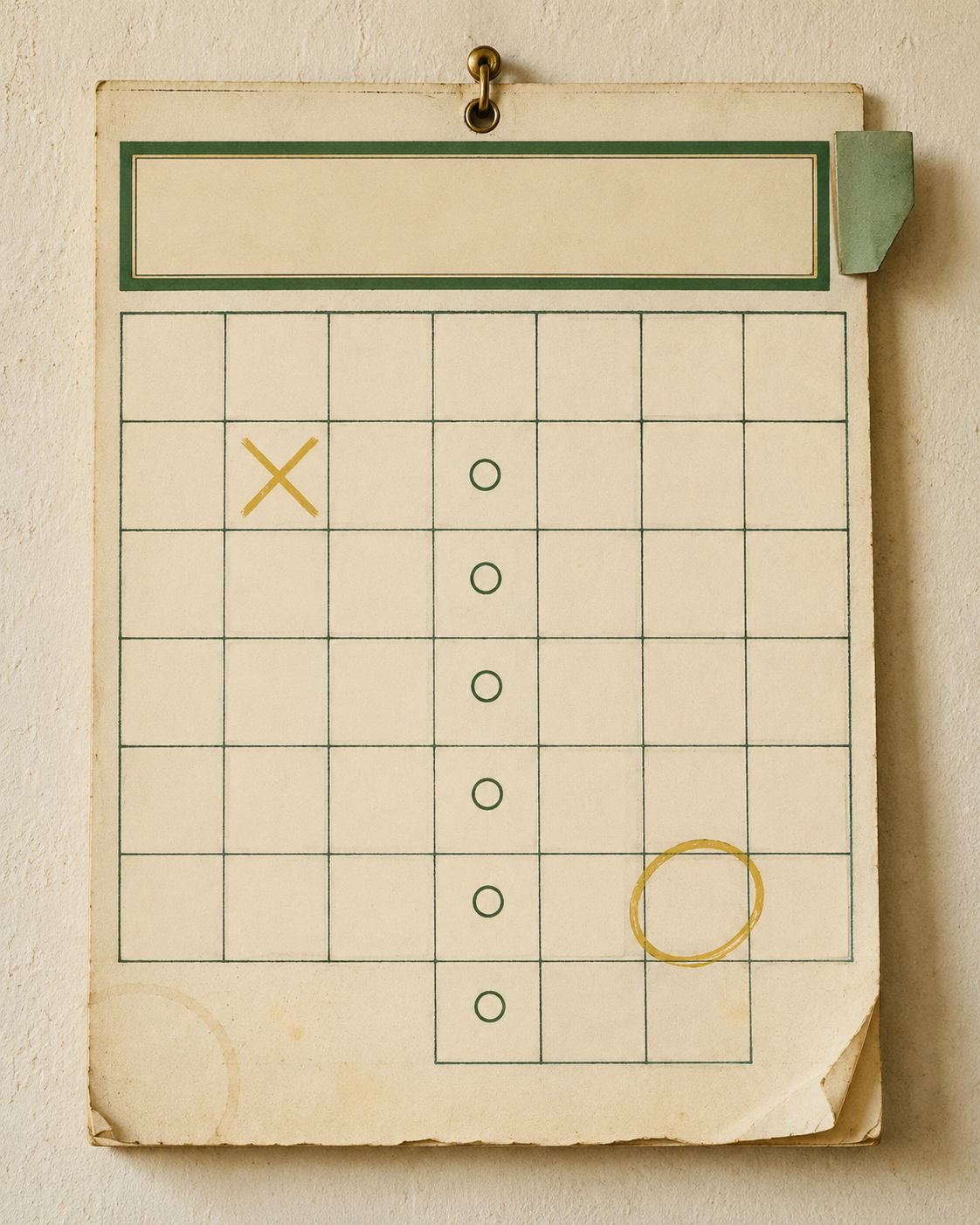
the anchor that replaces the deadline
The old anchor is behind you. The new one repeats. The score is a blank you don't control.
The Four Moves (This Is the Limbo Card)
Here's the whole thing on one screen. Screenshot it.
None of these need an app. None cost money. Do them in the first two weeks and the next eight take care of themselves.
1. Close the old goal — on paper, by hand. Write down three things: what you did well this cycle, what you noticed about your weak spots, and what you'll do regardless of the score. Ten minutes. This is the disengagement piece, not a gate you have to pass through, just one beam of the new structure.
2. Swap the outcome for an identity. Trade "I want to pass N2" for "I am someone who engages with Japanese daily." The first one dissolved on Sunday. The second one survives any score. This is the load-bearing line of the whole issue, and it's grounded in how habits actually stick — behavior lasts longest when it's cued by a stable routine and anchored in who you think you are (James Clear's popular way of putting it: your small daily actions are votes for an identity). Habit researchers have found that roughly 45% of what we do every day is habit, not fresh decision — so the goal is to make "touch Japanese" one of those automatic votes, not a daily willpower battle.
3. Pick one to three small projects for the next 6–8 weeks. Not "study N2." Too vague to ever start. Concrete: finish this graded reader. Watch one episode of that drama a week. Write three Japanese sentences after dinner on Tuesdays and Thursdays. The projects aren't the point — they're evidence for the identity.
4. Install the Sunday Reset. Twenty minutes, once a week, three written prompts. This is the one that holds the other three up. We'll walk through it in Renshuu Time — it's the center of gravity for this whole issue.
The headline rule, if you take nothing else: the limbo is not a study problem. It's an identity problem. And the fix is 20 minutes a week, not 2 hours a day.
Three weeks back, in The Test-Week Protocol, we mapped the behavioral plan for the ten days before the test — sleep, expressive writing, the morning-of routine. This issue is the mirror image: the motivation architecture for the eight weeks after. Same Mindset lineage, opposite end of the timeline. Together they close the loop on the whole JLPT cycle.
Two Learners, Same Tuesday
Same test. Same "probably passed" gut feeling walking out. Same 412 reviews on Tuesday.
Learner A decides to wait. "I'll see my score, then I'll figure out a plan." Reasonable-sounding. But the score doesn't land for weeks, so the whole limbo becomes a waiting room. Motivation is now outsourced to a number that hasn't arrived. Five weeks later the score comes back, and lands on a person who hasn't studied since the test.
Learner B runs a 20-minute Sunday Reset on July 12. Writes the identity sentence. Lists what they actually touched that week (not much, and that's fine). Picks one thing for next week. By the time the score arrives in late August, they've got seven quiet weeks of steady contact behind them and an identity that never depended on the result.
Here's the part that matters: whatever that score says, Learner B is in a completely different position. Pass? They've got momentum instead of a cold restart. Didn't pass? The score is data for the next cycle, not a verdict on a person who already walked away. The waiting stopped running the show.
That's the entire bet of this issue. Same score, two futures. The difference is 20 minutes on a Sunday.
⬆️ Level up レベルアップ
For advanced learners, the limbo has a sharper edge: the certificate-skill gap. You pass the highest level, and you still can't follow the TV news or a novel comfortably — and now you're sitting with "I have the paper and I don't feel fluent."
That's not you being a bad student. It's the predictable result of optimizing for a timed multiple-choice test and then expecting that slice to cover spontaneous, real-time, real-life Japanese. The test is honest about what it measures. It never claimed to measure fluency. So the reframe for this reader: swap the certificate-anchored identity ("I'm someone who passes the next level") for a usage-anchored one — "I am someone who reads, listens, and converses in Japanese daily." Same architecture, deeper integration.
One more, if you built a Japanese-only operating mode during the push: don't let it lapse in the limbo. Make your Sunday project a monolingual one — a Japanese-only podcast episode, or a 国語辞典 lookup of one word you half-knew this week. The mode you operate in is the mode you keep. Dropping back to bilingual now costs a month of the slow build it took to install.
Kanji of the Week: 待 📚
☕ Kanji of the Week
On'yomi: タイ
Kun'yomi: 待つ
Meaning: to wait; to wait for; to expect
Key words: 待つ (to wait) · 期待 (expectation, anticipation, hope) · 待合室 (waiting room)
Radical: 彳("step / going")on the left + 寺("temple")on the right. The left side means movement on a road; the right side, 寺, carries the sound and the sense of a still, patient place. Movement paused at a quiet spot — someone standing on the road, waiting.

Memory hint: Picture yourself walking a road (彳) and stopping at a temple (寺) to wait. Not pacing. Not refreshing your phone every ten minutes. Just standing quietly at a still place while time passes. That's 待 — waiting as something you do calmly, not something that's done to you.
This week's connection: The next eight weeks are one long 待つ. The question is which kind. 待つ can be the anxious kind — 期待 curdling into refreshing the results site at midnight. Or it can be the temple kind: standing at a still place, doing your quiet daily thing, while the score takes its time. This issue is about turning the first into the second.
New to kanji readings?
Learn how on'yomi and kun'yomi work →Renshuu Time 練習 📝
The First Sunday Reset. This coming Sunday — July 12, three days after this lands — sit down for 20 minutes and run it. Then repeat it every Sunday until the score drops in late August. Six or seven sessions total. The first one matters most, because it installs the habit.
(No answer key on this one — it's a practice, not a quiz. Just run the first Reset. We'll share what came back from the cohort next week.)
Grab plain paper and a pen (a single text file works if you must — just don't multitask). Write the identity sentence at the top: "I am someone who engages with Japanese daily." Current tense. A claim, not a wish. Then the three prompts:
→ Starter: Just write the identity sentence and answer Prompt 1 — What Japanese did I touch this week? List what actually happened. "Reviewed 40 cards Monday. Watched 12 minutes of a clip Wednesday." That's it. That's a real Reset.
→ Standard: All three prompts. Prompt 1: What did I touch this week? (Any contact counts. Do not edit it for what you "should" have done — write the truth.) Prompt 2: What's one specific thing I want to touch next week? (One. Not a plan. Concrete enough that on Saturday you'll know if it happened.) Prompt 3: Did the identity hold? Yes / no / sort-of. No paragraph. The one word is the whole answer.
→ Challenge: Do the Standard, then fold the page and stick it somewhere visible — the fridge, the back of your textbook, the bathroom mirror. Not for show. For the glance during the week. The glance is the second half of the practice.
You'll know you did it when: you have one folded sheet of paper by Sunday night — identity sentence up top, an honest list under Prompt 1, one observable commitment under Prompt 2, one word under Prompt 3. No points for length. The folded sheet is the proof.
Even if all you wrote was the identity sentence and the Prompt 1 list — that's already more goal-psychology work than 95% of test-takers will do all summer. Most people spend these weeks refreshing the results site. You wrote one sentence. That sentence is doing real work.
⬆️ Level up レベルアップ (optional)
Add a fourth prompt for the first three Resets — "If there were no JLPT at all, what would I be doing with my Japanese in six months?" Write the honest answer. If it's something the test helps with (a job, a visa, a credential), aim at the next level on purpose. If it's something the test can't give you (reading novels, following dramas without subs, holding a conversation), the next cycle might be the wrong frame entirely — and the Sunday Reset is now your architecture for the rest of the year. Neither answer is wrong. The only wrong move is defaulting to another test just because it's the structure lying around.
Last week's answers (The Test-Week Protocol): The dress rehearsal wasn't a quiz — it was a bug-hunt. The "answer key" was the debrief: three things that worked, three to adjust before the test, and your three if-then rules written by hand (if I'm stuck 60+ seconds, mark it and move on; if I freeze in 聴解, write the number and pick up at the next; if my heart races, one slow breath and refocus). If you ran it, you walked into July 5 with three data points most people don't have: your real caffeine response, your real breakfast effect, and your personal freeze point.
Tiny Win
You read a couple thousand words about the feelings after a test — no drills, no grammar, nothing you can point to as "productive" — and you didn't close the tab. Most people are refreshing the results page right now, trying to feel something. You're building the thing that keeps the language after the score fades. That's the move.
Further Reading (Optional)
For: Anyone sitting in the empty-after-the-goal feeling who wants to know it's normal.
Use: Ten minutes with an accessible write-up of the arrival fallacy — search "arrival fallacy Ben-Shahar" and read one plain-language piece, not a journal paper. Notice how little of it is specific to Japanese. That's the point.
Why it helps: Naming the feeling is half the relief. Once you see the empty-after-the-win pattern is universal and documented, it stops feeling like a verdict on your Japanese and starts feeling like weather — real, but passing.
So Here's the One Ask This Week
Run your first Sunday Reset on July 12. Then hit reply and tell us one thing you wrote down — not the whole list, just one thing you noticed about what you actually touched this week.
One reply. One thing. We read every single one — and the "sort-of" answers are the ones we write the next issue for.
Stay connected

🎧 Catch us on the Kotoba Brew podcast — Japan through its language, one word at a time. Listen here →
Follow us: X / Twitter · Reddit
これからも一緒に頑張りましょうね〜 💪
Until next Thursday,
— Kotoba Brew Editorial Desk