


The Test-Week Protocol
How to Show Up on July 5
{{first_name | みんな}}さん、こんにちは ☕
It is 2 AM. You are staring at the ceiling. Your phone is face-down on the nightstand and you are still doing flashcards in your head — 必要、必死、必ず — because if you stop, the panic gets louder.
The test is in ten days. Your last mock came in twelve points under the pass line. Your brain has decided the solution is to double your reviews this week and skip sleep.
We've been there. The instinct is wrong. And the research on why it's wrong has been sitting in academic journals since the 90s, almost completely untouched by JLPT prep blogs.
If this is the email you needed in the lead-up to a test, it'll be the email someone you know needs too. Subscribe or share →

The Cram Trap (and Why Your Gut Keeps Falling for It)
Here's what happens to the serious learner in the final 7 days.
Sunday: bad mock score. Monday: doubled Anki, fresh N2 grammar deck, sleep drops from 7.5 hours to 5. Wednesday: sore throat. Thursday: still not sleeping. Friday: 2 AM flashcards. Saturday morning: coffee on an empty stomach because "I'm too nervous to eat."
You walk into the test in a physiological state your body has never seen. The first reading passage takes twelve minutes instead of seven. Working memory is offline. You guess the last six questions on 読解.
That's not a Japanese-ability failure. That's a protocol failure. And nobody publishes the protocol.
Two weeks ago, we wrote the 6-week JLPT triage plan — the cognitive plan for what to cut and what to drill. This issue is the behavioral plan. What to do in the 7 days, 24 hours, and 60 minutes around the test. Together they're the full playbook.
You Are Not Under-Prepared. You Are Under-Protocoled.
The last 7 days before the JLPT are not for learning more Japanese. They are for engineering the cognitive and physiological state you walk into the test in.
That is a real distinction, not a slogan. The test-anxiety literature has been clear since the 1980s: for learners who've reached the threshold, the limiting factor in the final week isn't content learned. It's the state you show up in.
The protocol is free. It's evidence-based. It's the part of test prep nobody writes about.
The relief finding you need right now
If you only remember one thing from this issue, make it this.
A 2019 Fitbit study of college students by Okano and colleagues at MIT (npj Science of Learning) tracked sleep duration, quality, and consistency across an entire semester. The finding that matters for you: average sleep across the month before the exam strongly predicted performance. Sleep the single night before showed no significant correlation.
Read that twice.
One bad night before July 5 is not the catastrophe your brain is telling you it is. If the last three weeks of sleep have been roughly okay, a wobbly Saturday night will not sink the ship. The catastrophe is the cumulative sleep debt you build by doing 2 AM cram sessions every night that week.
So the rule for the final 7 days is the most boring rule we've ever published: hold your normal bedtime. We mean it.
Enjoying this? If someone forwarded you this issue, subscribe here so you don't miss next week's.
SubscribeThe Test-Week Protocol Card
Here's the whole thing on one screen. Screenshot this.
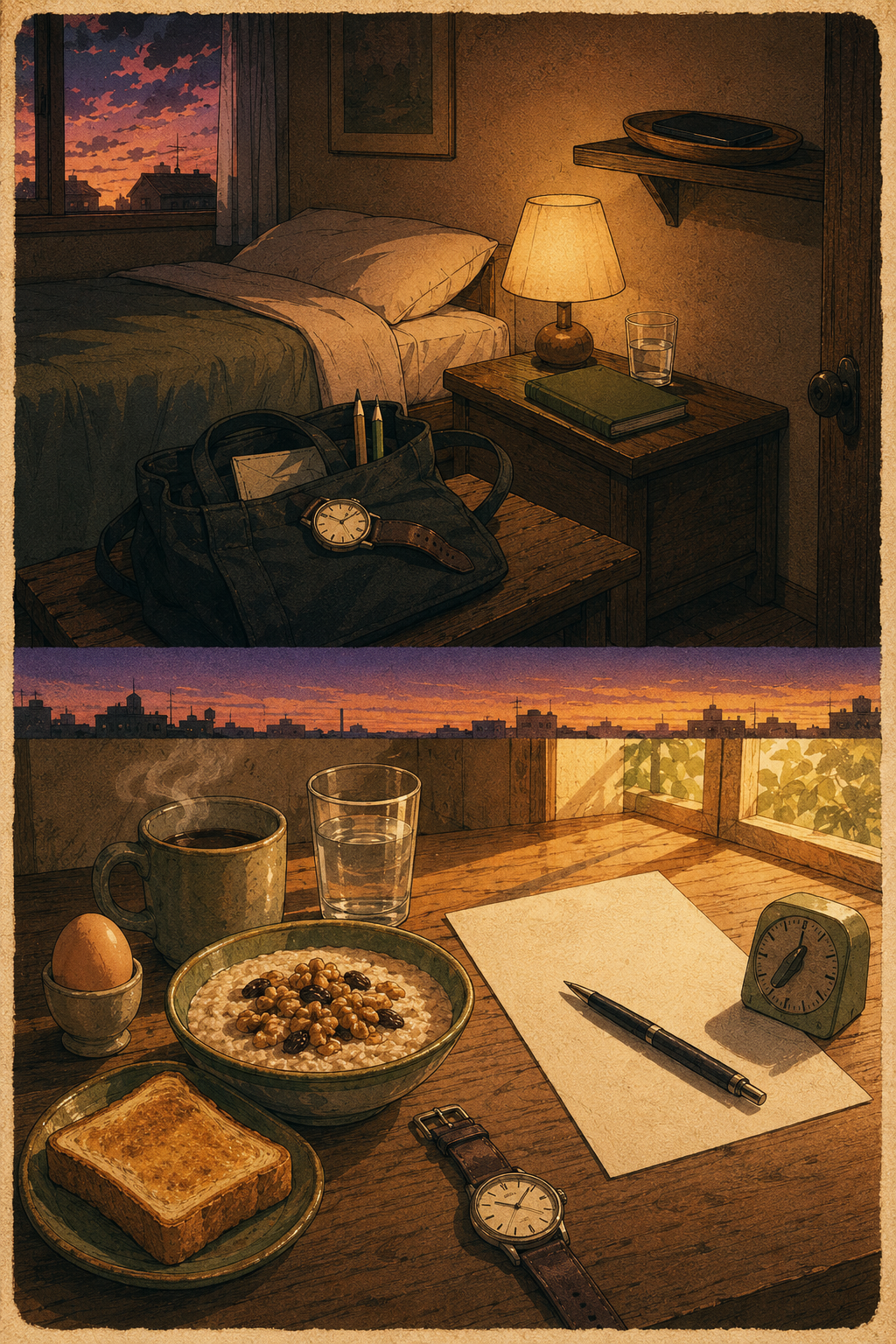
Final 7 days
→ Hold your normal sleep schedule. No new content.
→ Light retrieval only — drill the familiar.
→ One full timed mock at the time of day the real test runs, if (and only if) you have a full review day after.
→ No new grammar. No new kanji.
Day before (July 4)
→ Zero mocks. Zero new material.
→ 30–60 minutes of light, familiar review. That's it.
→ Pack your bag by 7 PM. Plan transport with a 30-minute buffer.
→ Eat a normal dinner. Bedtime within 30 minutes of normal. Phone away from the bed.
Morning of (July 5)
→ Real breakfast — slow carbs + protein + some fat. Oats with nuts. Onigiri with egg. Toast with peanut butter.
→ Habitual caffeine at habitual time, ~45–60 minutes before your start.
→ 10–15 min light Japanese warm-up. Graded reader or easy podcast. Not drills. Not hard listening.
→ 10 minutes of expressive writing (we'll explain in a second).
→ 2–5 minutes of slow breathing right before the door closes.
About the caffeine line: keep it qualitative. Moderate caffeine can help memory under the right conditions (Sherman et al., 2016, Frontiers in Psychology). But test day is not the day to experiment. Novel doses, doubled doses, or a coffee on an empty stomach when you don't normally drink coffee — the jitters and GI cost almost always outweigh the benefit.
And the start time on that protocol card? Match whatever start time is printed on your voucher. Centers vary, and the JLPT is not the morning to be guessing.
The 10-Minute Intervention Nobody Publishes
This is the part of the issue we'd circle in red if we could.
In 2011, Ramirez and Beilock ran two classroom experiments — one with 9th-grade biology students, one with college students — and published the result in Science (Writing about testing worries boosts exam performance, 331(6014), 211–213).
The intervention: ten minutes of expressive writing immediately before the exam. The instruction was almost embarrassingly simple. Write down your thoughts and feelings about the test you are about to take. Really let yourself go.
The result, for high-anxiety students specifically: roughly 0.4 to 0.6 standard deviations of improvement over high-anxiety controls who wrote about a neutral topic. Call it about a letter grade in the original classroom setting — that's a plain-language gloss, not a quoted statistic.
The mechanism is the part that makes sense once you hear it. Worry occupies working memory. The reading passages on the JLPT also need working memory. Expressive writing offloads the worry onto paper. The test gets the bandwidth back.
The exact protocol, adapted for July 5:
1. Twenty minutes before your section starts, sit down somewhere with paper and a pen.
2. Set a timer for ten minutes.
3. Write down every test-related worry you have. Don't censor. Don't make it neat. Don't write about worrying — write the actual worries.
4. When the timer goes, close the notebook. Don't reread it.
That's the whole thing. Ten minutes. Free. Almost nobody in the JLPT space talks about it. We will die on this hill: it is the highest-leverage ten minutes in test prep.
A note on honesty: this is not a magic wand. The effect is real but it is a nudge, not a guarantee. It is also strongest for people who actually feel anxious — if you're calm walking in, this isn't your highest-yield move. But if your stomach is in knots, this is the lever.
The Three Implementation Intentions (Write These Out This Week)
Here's the second secret-but-not-really intervention.
A 2006 meta-analysis by Gollwitzer and Sheeran (Implementation intentions and goal achievement, Advances in Experimental Social Psychology, 38) pooled 94 studies and found that simple if-then plans produce a medium-to-large effect on actually doing the thing you said you'd do (d ≈ 0.65). Pre-commit to "if X happens, then I do Y" rules, and the rule fires automatically when X shows up.
Translate that to the JLPT. The three predictable freeze points are: getting stuck on a question, freezing in 聴解, and feeling your heart rate spike.
Write these out. Read them before you walk in.
→ If I am stuck on a question for 60+ seconds, then I mark it and move on.
→ If I freeze in 聴解, then I write the question number and pick up at the next one.
→ If I notice my heart racing, then I take one slow breath and refocus on the next word.
You don't decide these on test day. You decide them now. The whole point is that the decision is already made when the panic hits.
⬆️ Level up: stamina, mode, and the repeat-sitter reframe
For advanced learners, three add-ons.
Stamina is the dominant risk, not knowledge. Listening collapses on cumulative attention fatigue, not on individual question difficulty. Two 20-minute timed listening blocks back-to-back, twice a week in the final fortnight, simulates the back-half-of-test exhaustion better than any single full mock. The morning-of warm-up should be easy listening — prime the comprehension mode, don't burn the capacity.
Mode continuity. If you've been operating in monolingual mode, do not switch back to bilingual lookups the morning of as a "comfort" move. The mode you train in is the mode you should test in.
The repeat-sitter reframe. If you've sat this level before and missed, the failure is almost never a language-ability failure — it's a pacing, state, or luck-of-the-draw failure. The protocol exists to remove the state variable from the equation. The score is signal about what to study next cycle. It is not signal about who you are as a learner.
Kanji of the Week: 解 📚
☕ Kanji of the Week
On'yomi: カイ、ゲ
Kun'yomi: 解く、解かす、解ける、解る
Meaning: untie, solve, understand, dissolve
Key words: 解く (to solve a problem) · 理解 (understanding) · 解答 (answer, solution) · 読解 (reading comprehension) · 解放 (release, liberation)
Radical: 角(horn)on the left + 刀(knife)over 牛(cow)on the right. The classical image: a knife untying the horn of an ox — the original concrete sense of "taking apart" that became "to solve, to understand."

Memory hint: The knife (刀) carefully separates the horn (角) from the ox (牛). Picture a careful untangling, not a violent cut. That's why 解 covers both "solve a math problem" and "dissolve in water" — same idea: something complicated comes apart.
This week's connection: Every section of the JLPT asks you to 解く — to untie a knot. 読解 is the section where the protocol matters most: working memory under time pressure. When you walk in with the protocol, you give 解く a fair shot.
New to kanji readings?
Learn how on'yomi and kun'yomi work →Renshuu Time 練習 📝
The Pre-Test Dress Rehearsal. Two Sundays from now (June 28, one week before the test), do one full dress rehearsal of the morning-of routine. This is the practice run that catches the bugs before they cost you the actual test.
(Answers — the debrief checklist — drop in next week's brew. Run the rehearsal first.)
→ Starter (45 minutes): Saturday night, pack your bag exactly as you would for July 5 — voucher, photo ID per your voucher's requirements, pencils, eraser, non-digital analog watch, water, a small snack. Sunday morning, eat your intended test-day breakfast at the time you'd eat it on July 5. Note how you feel 90 minutes in.
→ Standard (2 hours): Do the Starter, plus run the full morning sequence. Caffeine at your planned timing. 10 minutes of expressive writing on plain paper. 2–5 minutes of slow breathing. Then sit one full timed section at your level (for N3, that's the 100-minute 言語知識・読解 block; equivalent at your level). Phone in another room.
→ Challenge: Do the Standard at the exact start time printed on your voucher. After the section, write your three implementation intentions out by hand. Read them back. Note one thing you'd change before July 5.
You'll know you did it when: You have a written list of three things that worked, three things to adjust, and your three if-then rules on paper.
Even if all you did was the breakfast plus the expressive writing plus one section, you've already done more behavioral preparation than 95% of test-takers this cycle. Most people walk in cold. You walked in rehearsed.
⬆️ Level up (optional)
Add a back-to-back 聴解 block. Two 20-minute listening sets with a 2-minute break between. That's the stamina simulation.
Tiny Win
You read 2,000 words about a test that's ten days away and you didn't close the tab. Most learners are doom-scrolling Reddit right now looking for someone to tell them it'll be fine. You're building the protocol. That's the move.
One Resource
For: Anyone in the final 7 days who is itching to "study more."
Use: Drill the high-frequency core you've already met. Not new cards. Stop adding. Ten focused minutes a day for the next week.
Why it helps: The final week is for consolidating the familiar, not adding the unfamiliar. Our Jitsuryoku Kihon Anki deck is built exactly for this — a high-frequency core you can drill on autopilot when your brain is too anxious to learn new material. If you've been around since the SRS triage issue, this is that thesis at its sharpest: the final week is not for new cards. It is for the cards you already met.
For dress-rehearsal mock material, the official JLPT sample sets at jlpt.jp/e/samples/forlearners.html are free and format-accurate. Use them for the timed section in the rehearsal.
One thing not to do
No mocks in the final 48 hours. None.
Mocks spike cortisol. They cost sleep. The score has no actionable use because there's no review window left. The cram instinct will fight this rule hard. Trust the protocol over the instinct.
So Here's the Ask This Week
Pick your dress-rehearsal Sunday — June 28 is our suggestion. Block the morning. Write the three if-then rules on a piece of paper this weekend. Put them in the bag you'll carry on July 5.
Then hit reply with one word: rehearsed or wobbling. We read every one. The "wobbling" replies are the ones we write the next issue for.
Stay connected
🎧 Catch us on the Kotoba Brew podcast — Japan through its language, one word at a time. Listen here →
Follow us: X / Twitter · Reddit
これからも一緒に頑張りましょうね〜 💪
Until next Thursday,
— Kotoba Brew Editorial Desk