


The 17-Day Vocab Triage
Drop, Defer, Drill, Deploy — the 4-bucket rule for the final stretch
Study Systems · Vocabulary · JLPT
{{first_name | みんな}}さん、こんにちは ☕
It's a Sunday morning, seventeen days before the test. You open your SRS app. The due count is three hundred and twelve. By card forty, the same five words you've been failing since March cycle through again — 落ち着く, 仕方ない, 都合, 結局, 一応 — and you fail four of them, again.
Forty-seven minutes in, you look at the clock and realize the section you're actually weakest on hasn't been touched.
Then the thought arrives. Maybe I should just drop the leeches. Then the counter-thought, instantly, louder: but what if 落ち着く shows up in the reading passage?
So you keep grinding. You will do the same thing tomorrow.

At T-17 days, your vocab pile isn't a list. It's a sorting task.
Here's the move nobody hands you. Every card in your pile belongs in exactly one of four buckets — Drop, Defer, Drill, Deploy — and only one bucket gets your real attention for the next seventeen days.
The card you suspend today is not the card that beats you on test day. The card that beats you is the fragile one you kept brittle by spreading your attention across six hundred cold items.
That is the whole reframe. We will spend the rest of this issue on the rule, the buckets, the three-second test that sorts them, and a twenty-minute pile-sort you can do this Sunday.
Two notes before we go. We've zoomed out on the macro plan in The 6-Week JLPT Final-Push Plan — this issue is the vocab-triage zoom-in. And the reflex work we did last week in The 即時応答 Rescue lives downstream of the same idea: at T-17 days, retrieval speed on the things you almost-know beats coverage of the things you don't.
Permission to drop is the missing teaching here. We want to say that out loud before the sort, because the rule is useless if you can't grant it to yourself.
The four buckets, with a card living in each
Let's get the rule on the table. Then we'll walk a card through each bucket.
Drop. The card has failed many times (Anki's default tags a "leech" at 8 lapses — apply the equivalent in your SRS) AND the word sits outside your level's high-frequency block. Suspend it. The agonizing is the trap. These cards aren't crossing threshold in seventeen days; trying will cost you the cards that would have.
Defer. The card is new — you've never answered it correctly — and it's outside the high-frequency block. Move it to a "post-July" deck. Suspended for now. It comes back July 6 like nothing happened.
Drill. The card is fragile. You recognize it slowly. You can sometimes recall the meaning but not the reading, or the reading but not the meaning. This is the bucket that wins or loses your test. Sixty to seventy percent of your daily vocab time goes here.
Deploy. The card is reliable. Recall under three seconds. Multiple successful retrievals in a row. You'd bet money on it. Light spaced touches only — ten to fifteen minutes a day. The goal isn't to learn it. The goal is to keep it warm.
A receptive-vs-productive note before we go further, because this is where the rule earns the reframe.
You almost certainly recognize more Japanese than you can produce. The vocabulary literature (Webb 2008; Laufer 1998; with Schmitt 2014 and Nation 2013 explicitly cautioning against any universal multiplier) puts the surplus somewhere between roughly 1.1× and 2×, depending on proficiency and how strictly "production" is measured. The exact number matters less than the direction. The JLPT only tests the recognition side. A card you can match to a meaning when you see it on the page is a JLPT-ready card, even if you couldn't produce it from English in a million years. That is permission, not a corner-cut.
Now the three-second test. Apply it to every card during triage.
See the front. Count out loud: one Mississippi, two Mississippi, three Mississippi. (Or whatever three-second beat works in your head.)
→ Recalled by "one": Deploy.
→ Recalled by "three": Drill — fragile, your gold bucket.
→ Recognized but not recalled, high-frequency: Drill.
→ Recognized but not recalled, low-frequency: Defer.
→ Not recognized at all, new card: Defer.
→ Not recognized at all, lapsed past your leech threshold: Drop.
Counting out loud matters. Silent counting is where the "I almost knew it" lie sneaks back in and contaminates the sort.
A note on the frequency bands, because we're going to use them in the next breath and we owe you the disclaimer first. There is no official JLPT vocabulary list. The Japan Foundation has never published one. So when we say "high-frequency block," we mean a working heuristic that almost every prep tool already uses: rank the card against a published frequency list (jpdb.io is the cleanest, or Tanos's lists, or the Core 6k/10k decks). For test-takers aiming at the intermediate band, drop candidates sitting outside roughly the top three thousand most-frequent words. For upper-intermediate, the working line is around the top six thousand. For advanced, around ten thousand. These are planning targets, not boundaries the JLPT enforces.
Now the four cards. Live examples, one per bucket.
→ 学校 → Deploy. You've known it since week one. Recall under a second. Touch it once every two or three days, that's it.
→ 落ち着く → Drill. You recognize it. You recall おちつく on a slow day and freeze on the meaning on a worse day. This is gold. Hammer it.
→ 馴染む → Defer. Brand new card, never answered correctly, lower-frequency in your reading materials. Suspend until July 6.
→ 一概に → Drop. Low-frequency adverb, you've failed it more times than you've fingers. Suspend. The card you drop here is not the card that beats you on test day.
The trap most learners walk into is treating every due card as equally worth processing today. They aren't. The expected value of a card depends on its frequency, its current retrieval state, and how many days are left. At seventeen days out, roughly half your queue has negative expected value. Triaging is the highest-yield twenty minutes you'll spend this month.
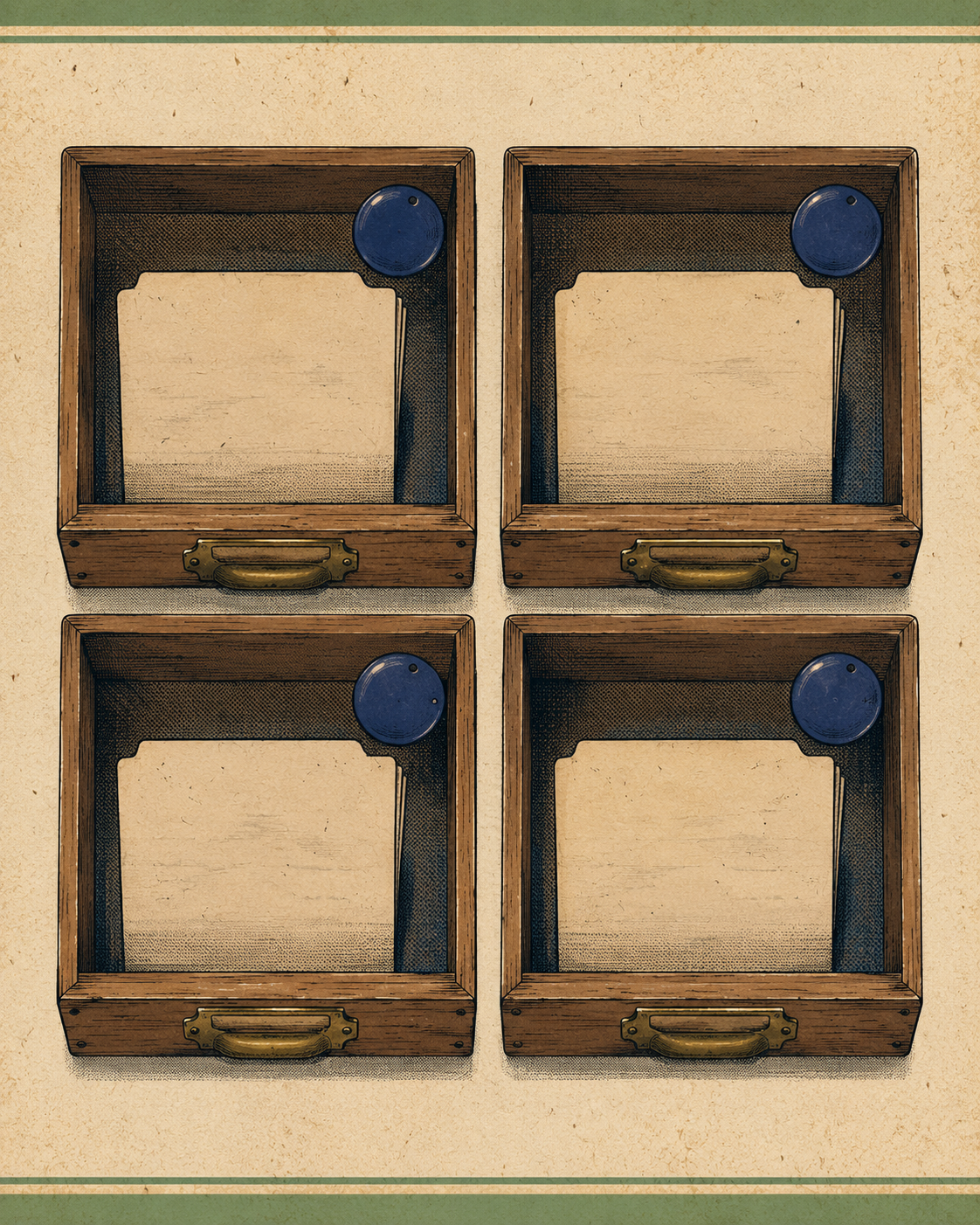
The 4-Bucket Decision Card
|
Drop Failed past leech threshold + outside high-frequency. Suspend. 一概に |
Defer New, never answered correctly + outside high-frequency. Suspend to post-July. 馴染む |
|
Drill Fragile. Recognized slowly. Recall under 3 sec. 60–70% of vocab time. 落ち着く |
Deploy Reliable. Recall under 1 sec. Light maintenance only. 学校 |
The math nobody walks you through
The default SRS algorithm optimizes long-term retention given infinite time. You don't have infinite time. You have seventeen days. The optimization function changed three weeks ago and nobody told the algorithm.
So the time allocation has to change too. Roughly:
→ Drill bucket: about 30 minutes a day of focused retrieval on the fragile pile. Pre-sorted, no decision overhead, no new cards added.
→ Deploy bucket: about 10 minutes a day of light maintenance to keep reliable cards warm.
→ Drop and Defer buckets: zero minutes. Suspended. You'll see them July 6.
What we just bought you, versus grinding a ninety-minute leech queue, is somewhere between thirty and forty-five minutes a day. The swing depends on how big your queue actually is — readers with a hundred due cards will land at the lower end, readers with six hundred at the higher one. Over seventeen days, that's roughly four to seven hours of attention you can move to mock-test pacing, the listening drill from last week, or the reading-speed work from the issue before.
That is a score move. It is also, structurally, what consistency-over-intensity actually looks like in the last stretch. Twenty minutes of triage today plus thirty minutes of focused drill per day for seventeen days beats one panicked Saturday binge through six hundred cold cards. The literature on retrieval practice (Roediger & Karpicke 2006; the Adesope et al. 2017 meta-analysis puts the effect at around g ≈ 0.50) is clear that retrieval reps compound on cards you almost know. They don't compound on cold cards. Almost-knowing is the precondition. The Drill bucket is where almost-knowing lives.
One more thing about the suspend-anxiety paradox before we move on. "If I drop it, the test will show me exactly that card" is loss aversion plus magical thinking under pressure. It is a real, predictable cognitive pattern, and naming it is most of the cure. The actual decision criterion is frequency plus retrieval state. Not anxiety plus superstition.
One ask this week
How big is your leech pile?
Hit reply with three things: roughly how big your leech pile actually is (a count is fine), the top three cards you're most stuck on, and which bucket you suspect each one belongs in. We read every reply. If a clear pattern shows up across the cohort, we'll pull the top stuck-card list into next week's brew so the whole list gets the cohort's collective triage.
Reply to this email — goes straight to [email protected]
Level up レベルアップ
⬆️ Level up
Three nuances the core protocol skips, for the higher-band test-takers.
First, a monolingual-only check on the Deploy bucket. If you can recognize 落ち着く from the kanji+kana front but only via an English gloss or only via your own kanji intuition, that's a fragile-passing-as-reliable. Tag it as Drill instead. Most "I passed the higher level but the score was tight" failures live in this gap.
Second, collocation reliability beats word reliability at the top end. The test rewards words inside their natural collocations (落ち着いて〜する, 結局〜になる). A word that's Deploy in isolation can be Drill in collocation. Cheaper version: run the second triage only on the top hundred most-frequent words.
Third, the productive-by-genre rule. If you've got a job placement test or oral exam sitting alongside the JLPT, narrow the receptive-acceptance rule for the items you actually need to produce in that other test. The JLPT-only optimization is recognition; the dual-test optimization is recognition-plus-production for a small, named set.
Kanji of the Week: 捨 📚

☕ Kanji of the Week
On'yomi: シャ
Kun'yomi: す・てる
Meaning: Throw away, discard, abandon, let go of. The kanji at the heart of the Drop bucket.
Key words: 捨てる (to throw away, to discard) · 取捨選択 (selection — literally "take-discard-choose-select," the four-character idiom for triage itself) · 見捨てる (to give up on, to abandon — compounds with 見る "to see/regard")
Components: 扌 (てへん, "hand") on the left + 舎 (a building / shelter) on the right. A hand setting something down at the threshold of a building. Putting it outside the house.
Memory hint: Picture yourself at the doorway of your apartment with a card in your hand. Not destroying it. Not burning it. Just setting it down outside, gently, so the people inside can breathe. That's 捨. It's not violence. It's making room.
This week's connection: 取捨選択 is the four-character idiom for what this whole issue is about. Take what's worth taking. Discard what isn't. Choose where attention goes. The Drop bucket isn't a wound — it's a 捨, in the 取捨選択 sense. The cards you set down outside the house at T-17 days are the cost of admission for the cards inside getting the attention they need.
New to kanji readings? Learn how on'yomi and kun'yomi work →
Renshuu Time 練習 📝
The 20-Minute Pile Sort — do this once, this Sunday June 22 at the latest.
Open your primary vocab deck (Anki, Bunpro, Renshuu, jpdb — whichever has your largest backlog). Set a 20-minute timer. For the first fifty due-or-new cards in your queue, apply the three-second count-out-loud test and drop each card into a bucket using the rule from the Deep Dive. At the timer, stop. Count your buckets.
(No literal answer key — we'll share the cohort distribution and a tactical follow-up in next week's brew. Try the sort first.)
→ Starter: Sort 25 cards. Even half a session is a real triage. The buckets still work.
→ Standard: All 50 cards, all four buckets, tagged in your SRS. Tomorrow morning, study only the Drill-tagged cards. Add no new ones.
→ Challenge: 50 cards plus a second pass on the top-100 frequency words in your deck, this time scoring them on collocation (Level Up gate). Re-tag anything Deploy-in-isolation that's Drill-in-collocation.
You'll know you did it when: You can open your SRS app and every card you see is one you've explicitly decided is worth your attention today. No leech cycling. No mid-review agonizing. Every card is in a bucket, and the bucket has a behavior.
If your Drop bucket comes out to 40% of the pile, that's not failure — that's success. The cards you suspended were the ones that weren't going to move in 17 days anyway. You just freed the attention for the 60% that will. Even half a session (twenty-five cards triaged in ten minutes) is a real score move. ✨
⬆️ Level up (optional)
After the sort, write down your bucket counts (Drop / Defer / Drill / Deploy) and the three Drill-bucket words you most want to nail by July 5. That tiny written commitment is the seed of the next seventeen days' focus.
Last week's answers (The 即時応答 Rescue): No literal key — that one was a reflex drill. Three patterns to flag, based on the brief's pedagogy and the early replies. Pattern 1: 確認 (confirmation, the 〜だったっけ form) is the most-missed speech-act category. Most learners parse it as a question and reach for an answer reply when the prompt wants a confirmation reply. Pattern 2: 申し出 (offer) and 勧誘 (invitation) collapse together around 〜ましょうか. The fix is asking "is the speaker doing it alone, or proposing we both do it?" Pattern 3: pragmatics errors outnumber parsing errors at the plateau levels. The fix isn't more grammar. It's ten more reps of the function-to-chunk match.
Tiny Win
If you only sort twenty-five cards tomorrow morning and suspend the ten that have been failing since March, you've already done more vocab triage than most of the cohort will between now and July 5. That's the bar. One bucket, one decision, one less card cycling through your reviews tomorrow.
Further reading (optional)
For: Plateau fighters who want a frequency reference to rank their cards against during the pile sort.
Use: jpdb.io — paste any Japanese word, get its frequency rank against a real corpus in two seconds. Use it during Sunday's triage as your high-frequency / low-frequency check.
Why it helps: The bucket rule depends on knowing where a card sits in frequency. Without that anchor, "drop the low-frequency leeches" stays abstract. With it, the call is mechanical. If you don't want a new tool, the Core 6k/10k Anki deck order works the same way — anything in the deck is high-frequency by definition.
これからも一緒に頑張りましょうね〜 💪
Stay connected
🎧 Catch us on the Kotoba Brew podcast — Japan through its language, one word at a time. Listen here →
Follow us: X / Twitter · Reddit
Until next week,
— Kotoba Brew Editorial Desk