

The 即時応答 Rescue
Why the last listening section ambushes everyone — and the 3-step rule that stops it
Language Deep-Dive · JLPT · N3–N1
{{first_name | みんな}}さん、こんにちは ☕
There's a section in the JLPT listening test that even strong readers tank on. It plays one short line. Three replies. Nothing is printed except a number. By the time your brain finishes translating, the options are already gone and you're picking on a vibe.
You finish the mock and check the sub-scores. Every other listening block looks survivable. This one looks random.
Readers describe it the same way every cycle: I just blank out. If that's been your worst sub-score, it's the worst sub-score for a lot of readers — including the ones who pass the rest of the test comfortably.
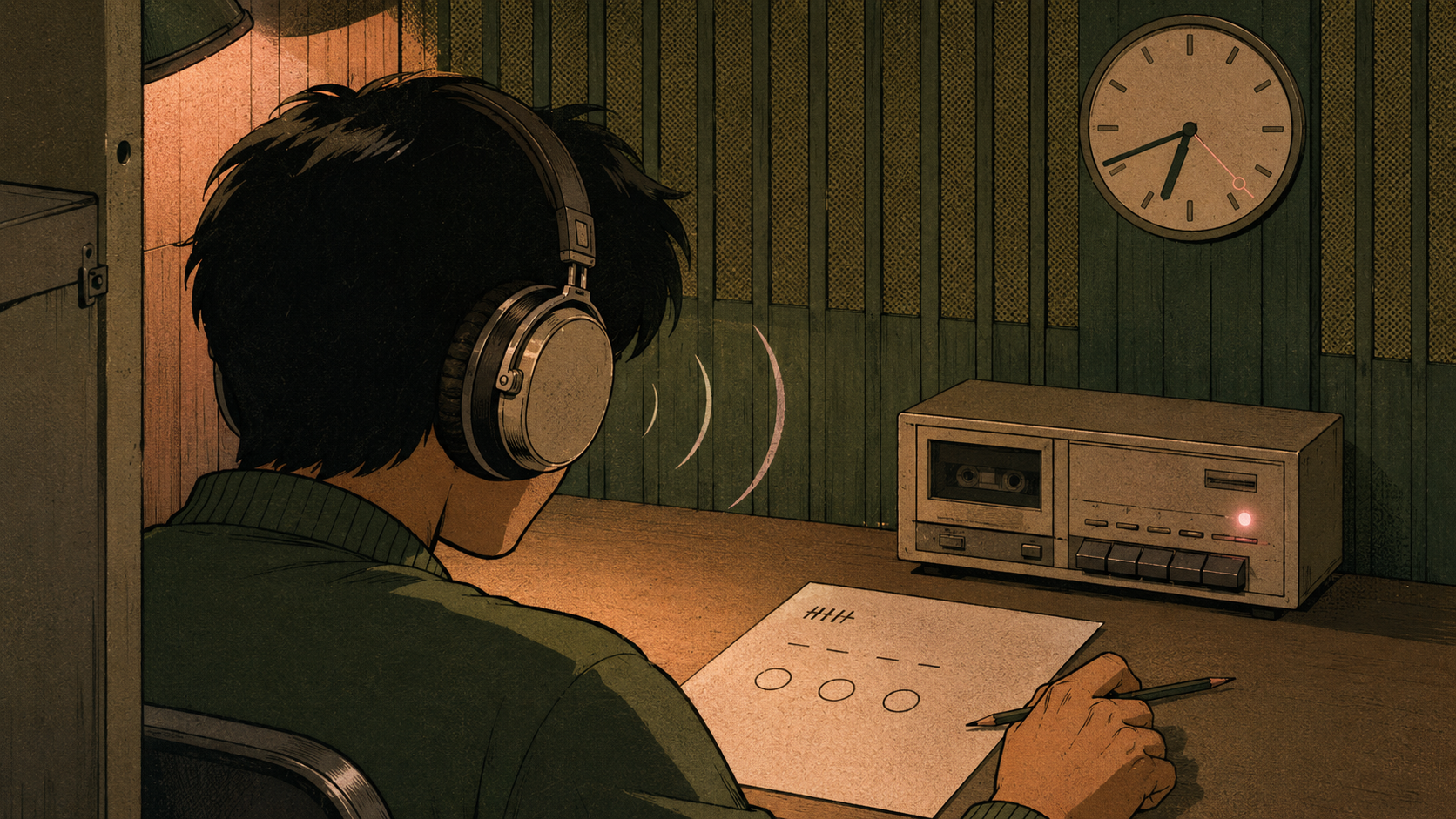
The section is engineered to ambush. That's not on you.
The section is called 即時応答 — "quick response." At N1 it's eleven of the thirty listening questions. That's about 37% of your N1 listening items riding on a sub-format almost nobody trains for explicitly.
At N2 it's around nine to ten. At N3 it sits next to 発話表現 for roughly eight to ten between them.
Standard prep materials mention the section exists and then move on to longer-passage strategy. That's the gap.
Here's the part the gap is hiding. 即時応答 isn't really a listening test. It's a pragmatic reflex test wearing a listening costume.
Audio plays once. Options are spoken, not printed. You get two or three seconds. The section rewards a specific reflex (pragmatic pattern-matching) that anime, podcasts, and general shadowing do not train directly.
Which is the good news, if you're 24 days out from the July test. Reflexes are trainable on short timelines. Vocabulary cramming isn't.
We're going to walk through the actual cognitive procedure (three steps, in order) that you can run in real time during the test. Then a ten-minute daily drill that makes it stick.
Same prompt, three replies, only one natural
The whole section lives inside small contrasts like this one.
Prompt: 「明日の会議、何時からだったっけ?」 — "What time was tomorrow's meeting again?"
a. 「3時からです」
"It starts at 3."
b. 「3時からだったよ」
"It was from 3."
c. 「3時にしましょうか」
"Shall we make it 3?"
All three are grammatical. Only one is a natural reply to a colleague performing a 確認 — a confirmation-seeking question, marked by 〜だったっけ.
The difference: 確認 wants a confirmation answer, not a fresh proposal. c proposes a new time. b confirms the time the speaker is half-remembering. b is the reply.
The trap is that on the page, you'd catch this in five seconds. At spoken speed, with options playing once, you don't.
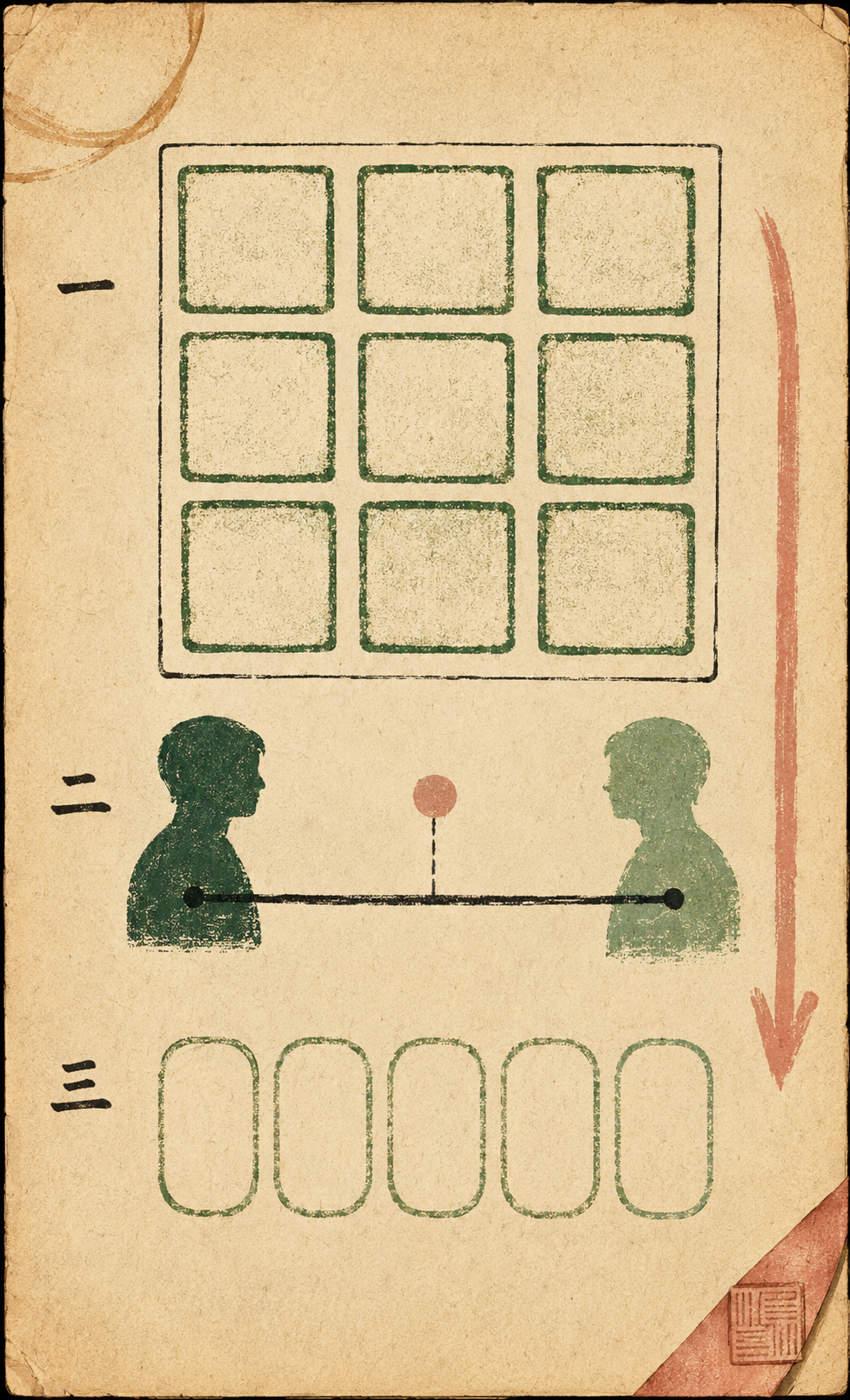
The 3-step rule: speech act → who acts next → stored chunk
Most JLPT listening tips say "practice more" or "read the options first." The second one is impossible here — options aren't printed. So we need the actual cognitive procedure, the one you can run while the audio is still playing.
Three steps. In order.
Step 1 — Identify the speech act in the first one or two seconds.
A speech act is what the utterance is doing, not what it's saying. Japanese pragmatics has a standard inventory, the same one Japanese textbooks and SLA papers use. Eight or nine categories cover almost everything you'll hear on the test.
→ 依頼 — request: "Can you do X?"
→ 断り — refusal: "Sorry, I can't."
→ 謝罪 — apology: "I'm sorry about X."
→ 勧誘 — invitation: "Want to come?"
→ 提案 — suggestion: "How about X?"
→ 申し出 — offer: "Let me do X."
→ 不満 — complaint: "X is bothering me."
→ 確認 — confirmation: "It was X, right?"
→ 感謝 — thanks: "Thank you for X."
That's the working set. Memorize the Japanese terms. They're the labels actual JLPT prep materials use, and they'll show up in your future reading. Half the credibility of this section comes from learning the field's actual vocabulary instead of made-up English glosses.
Step 2 — Who acts next? 話し手 or 聞き手?
This is the pivot. One question collapses about a third of the section's apparent ambiguity.
The speaker (話し手) is the person whose voice you just heard in the prompt. The listener (聞き手) is whoever they're talking to (usually the test-taker, narratively). The right reply depends on who's about to take action.
Watch what one syllable does here. 〜してください → listener acts ("Please do X"). 〜させてください → speaker asks permission to act ("Please let me do X"). 〜ましょうか → speaker offers or proposes joint action. Three forms, three different "who acts next" answers, all hiding inside a 〜ください ending. If you can tag the form in real time, you've already ruled out two of the three options before you parse meaning.
Step 3 — Match to a stored response chunk by function.
Once you know the speech act and who acts next, you don't have to compose a reply. You reach for one already on the shelf. Native speakers do this. Test-takers can too.
A starter chunk bank:
→ Apology received → 「いえいえ」 / 「お気になさらないでください」
→ Polite refusal → 「ちょっと…」 / 「今回はやめておきます」
→ Accept a suggestion → 「そうしましょう」 / 「そのほうがいいですね」
→ Accept an offer → 「ありがとうございます、お願いします」
→ Confirm (〜だったっけ) → 「〜でしたよ」 / 「〜だったよ」
You don't need a hundred of these. You need ten or twelve that fire automatically. Speed of retrieval beats library size.
The trap most learners walk into is assuming this section is testing Japanese knowledge. It isn't. It's testing chunk retrieval speed under a social-pragmatic constraint. "I just need more vocab" is the wrong drug at the wrong dose. Yasu (a JLPT teacher whose diagnostic we've been borrowing) puts it this way: if you can answer the question correctly when reading the printed script, it isn't a knowledge problem. It's a processing problem. Different fix.
The minimal-pair trap (where strong readers tank)
This is where the section gets ugly for plateau fighters.
〜ましょうか vs 〜てくれますか — speaker-offers vs request-of-listener. Two grammatically clean responses are wrong. One is the reply.
〜してください vs 〜させてください — one syllable changes who acts.
〜だったっけ vs 〜にしましょうか — confirmation vs fresh proposal.
In print, you'd catch every one of these. At 0.8× cognitive speed in real time, with three replies playing in a row, your parser misses the cue and your hand picks the grammatically-correct-but-pragmatically-wrong option.
That's the failure mode. It's not a Japanese gap. It's a reflex gap. You need to build a parser that catches the cue before the meaning resolves.
One ask this week
Which speech act ambushed you?
Hit reply with two things: your level, and which speech act category from the list above you couldn't tag on the fly. We read every reply. If a pattern shows up across the cohort, we'll publish the top-three "ambush categories" in next week's brew so you can target them directly.
Reply to this email — goes straight to [email protected]
Level up レベルアップ
⬆️ Level up
The harder prompts bury the speech act inside a subordinate clause: 「もし時間があれば、ちょっと寄ってもらいたいんですが…」 — the soft request is hiding inside a conditional, with the actual ask in 〜てもらいたい at the end.
Itabashi (2020) ran a study on 即時応答 with 45 intermediate-to-advanced learners. The items focused on テ形 subordinate clauses and case-particle cues for who's acting. The finding worth carrying into your drill: even strong learners systematically misread prompts when the speech act sits inside a subordinate clause. The failure wasn't vocabulary. It was parsing under time pressure.
The fix: at this tier, shift Pass 1 of the drill (below) to isolate prompts with conditional (〜ば / 〜たら / 〜なら), embedded quotation (〜と言って), or keigo layering. Train the parse separately from the response. The three-step rule stays, but the parsing window has to be wider, and your ear has to wait until the verb at the end before it locks in.
Register also matters more at this tier. 「申し訳ないんですが、ちょっとお時間いただけますでしょうか」 and 「ねえ、ちょっといい?」 are the same speech act (a request for time) but the right response register is wildly different. Train both.
Kanji of the Week: 即 📚

☕ Kanji of the Week
On'yomi: ソク
Kun'yomi: すなわ・ち (rare; jōyō also lists つ・く and つ・ける, almost always written 就く / 就ける in practice)
Meaning: Immediate, on the spot, at once. The "now" baked into 即時応答.
Key words: 即時 (immediate, instant — as in 即時応答) · 即答 (prompt/immediate reply) · 即席 (instant, off-the-cuff — 即席ラーメン = instant ramen, yes really)
Components: 卩 (ふしづくり, "kneeling person") is the indexing radical, on the right; 皀 (food vessel) sits on the left. A person seated immediately at the table, ready to eat. The kanji literally pictures "right now, at this seat."
Memory hint: Picture yourself sitting down at a counter the second the food is placed in front of you. No waiting, no debating. 即 is that exact beat: the one between the bowl landing and your chopsticks moving. That's also the beat the JLPT is testing in 即時応答.
This week's connection: 即 is the kanji that names the whole problem. 即時 = "the immediate moment." 応答 = "response." Eleven N1 questions are asking whether your response can keep up with the immediate moment. The kanji is the problem statement.
New to kanji readings? Learn how on'yomi and kun'yomi work →
Renshuu Time 練習 📝
The 10-Minute 即時応答 Reflex Drill — do this 5 of the next 7 days.
Open any JLPT 聴解 past-paper audio, 新完全マスター, or a YouTube playlist of 「JLPT 即時応答 練習」. Your SRS system might have these as cards too. Find one 即時応答 set. Then run three short passes.
Pass 1 (3 minutes) — label only. Play only the prompt utterance. Skip the options. After each prompt, say out loud: the speech act is ___, the next actor is 話し手 / 聞き手. Don't pick a reply. Just tag.
Pass 2 (4 minutes) — generate. Replay each prompt. Speak your own natural reply aloud before the official options play. Don't pick. Generate. This is the chunk-retrieval rep.
Pass 3 (3 minutes) — pick under timer. Play prompt + three options at normal speed. Pick under a hard 3-second timer. Then check the script and grade your error type: was it perception (you misheard), parsing (you missed the grammar), or pragmatics (you picked a grammatically-fine but socially-off reply)?
(No literal answer key — this is a reflex drill. Pattern reveal drops in next week's brew.)
→ Starter: Run Pass 1 only. Three minutes a day, label-only. That alone is more targeted than 20 minutes of anime.
→ Standard: All three passes, five days this week.
→ Challenge: All three passes plus a Level Up filter — only use prompts with embedded conditionals, quotations, or keigo layering.
You'll know you did it when: You can name the speech act of each prompt within 2 seconds, even on the ones you eventually get wrong on the reply. The reflex is the win, not the score.
If you only run Pass 1 for one week (three minutes a day labeling speech acts) you've trained the exact reflex the section measures. That's a real chunk of points back on a section nobody warned you about. 三週間で十分です。 ✨
⬆️ Level up (optional)
Track your error types across the week. If "pragmatics" dominates, you need more chunk-bank reps. If "parsing" dominates, you need to widen your listening window. Wait for the verb at the end.
Last week's answers (The Reading-Speed Trap): No literal key — that was a measurement drill. Early replies are clustering around three patterns (fuller results when more numbers land). Most N3 readers report somewhere between 150 and 200 chars/min on first measure, which is the textbook plateau and exactly what the drill is for. N2 readers tend to cluster around 220–280, just under the 250–350 target. Speed gap, not comprehension. And almost everyone who reported a "comprehension fine, time bad" mock matched the diagnostic profile: drop the new graded reader, pick up the stopwatch.
Tiny Win
If you only do Pass 1 for three minutes tomorrow morning (label the speech act, name the next actor, move on) you've trained more 即時応答 reflex than 95% of test-takers will between now and July 5. The bar is on the floor. You only need to label one prompt.
Further reading (optional)
For: Plateau fighters who want one structured source of 即時応答 prompts that match real test pacing.
Use: 新完全マスター聴解 N2 or N1. Open the 即時応答 chapter, run the three-pass drill on one set per session. Ten minutes total. Don't binge.
Why it helps: The prompts are written at JLPT pacing, the speech acts are intentionally varied across the chapter, and the audio is the closest you'll get to the real test without a past-paper download. If you don't have it, a YouTube playlist of 「JLPT 即時応答 練習」 works for the same drill.
これからも一緒に頑張りましょうね〜 💪
Stay connected
🎧 Catch us on the Kotoba Brew podcast — Japan through its language, one word at a time. Listen here →
Follow us: X / Twitter · Reddit
Until next week,
— Kotoba Brew Editorial Desk