

The Order You Study In
Why Your Second Task Gets Your Worst Attention
{{first_name | みんな}}さん、こんにちは ☕
It's Tuesday night. You've got one good hour.
So you open your SRS first — because that's the responsible move, right? Clear the queue, protect the streak. The number says 340. You start pressing "Good."
Somewhere around card 180 the fronts start blurring. You're on autopilot now, half-reading, thumb doing the work your brain checked out of. Forty-five minutes later the queue is empty, the streak is intact, and your head is sandblasted.
Then you open the graded reader — the thing that was actually supposed to be the point tonight. And the first paragraph just… won't stick. You read the same sentence three times. You close the app after eight minutes and tell yourself reviews count as studying too.
Here's the part nobody warns you about: that wasn't a discipline problem. It was an ordering problem. And there's one reason your perfect-streak weeks keep failing to move your Japanese — we'll get there.
If this reorder clicks for you, it'll click for someone whose Anki streak is also perfect and whose reading is also stalled. Subscribe or share →
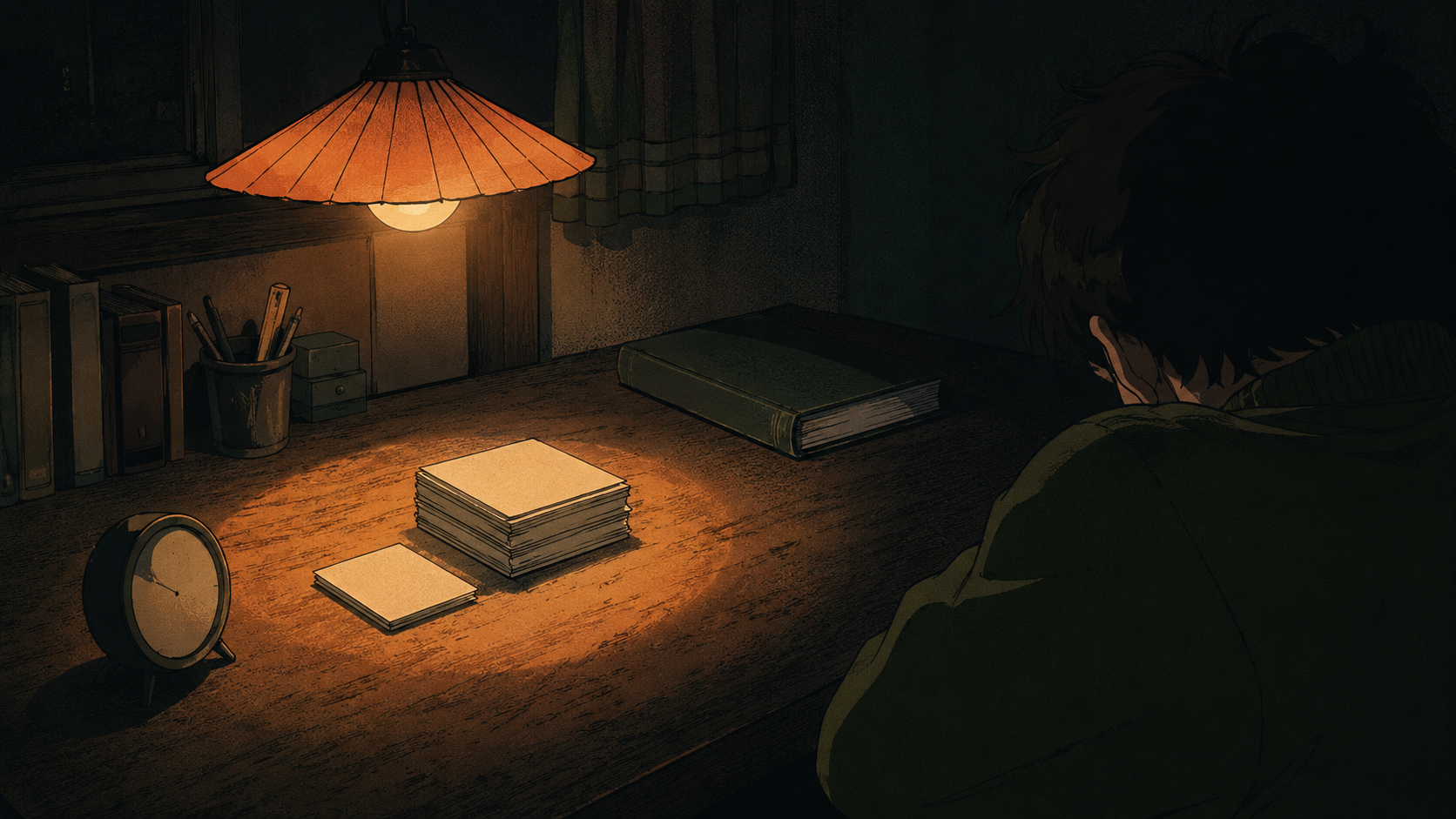
Your Best Hour Is Going to Your Easiest Task
Every study session runs on a hidden budget. Not time — attention.
You start sharp. Then, after a stretch of focused effort, you get measurably duller. This isn't a motivation thing or a "you're not a morning person" thing. It's just how sustained attention works: performance on effortful tasks drops the longer you stay on task, and that fatigue carries into whatever you do next.
Read that last part again, because it's the whole issue: whatever you do second gets a degraded version of your attention.
You don't get to opt out of that tax. You only get to choose which task pays it.
And that changes one simple question. Most people sit down and ask "what should I do first?" Wrong question. The one that actually matters: which of my tasks is too effortful to survive being second?
That task — whatever it is for you — goes first. Everything that can survive a tired brain goes after it.
Simple rule. But it collides head-on with the most repeated piece of study advice in the entire immersion world. So let's talk about that.
The Advice That's Quietly Sabotaging You
"Do your reviews first, while you're fresh."
You've heard it a hundred times. It's the water everyone in this hobby swims in — front-load the SRS while your concentration is high, then immerse after. Some routines hard-code it: certain apps open straight onto your due reviews before anything else. Mostly, though, it's just folk wisdom. The obvious-sounding instinct you absorb from a thousand routine threads: clear Anki first, get it out of the way, then do the real stuff.
We inherited it too. For a long time it felt like the disciplined thing to do.
Here's the flip: for an intermediate learner with a mostly-mature deck, reviewing known cards is usually the lowest-effort task in your whole session — not the highest.
Think about what a mature-card review actually is. You see 学校, you already know it's "school," you press "Good," next card. It's a quick, self-contained retrieval of something already familiar. Low integration. Low load.
Now compare that to reading a real paragraph with a dictionary open. You're holding three half-parsed clauses in your head while you look up an unfamiliar word — juggling meaning, grammar, and context all at once, because none of it is automatic yet. L2 reading leans hard on working memory precisely because so little of it runs on autopilot.
To be clear — this is comparative, not absolute. We're not saying "reading is objectively harder than Anki" for everyone. For a beginner grinding a hundred brand-new cards, SRS might genuinely be the hardest thing on the table — and then it should go first. The rule bends to your level. The slogan doesn't.
But if your deck is mature and you're following "reviews first" faithfully, look at what that means: you're handing your sharpest, freshest hour to your easiest task. Then you're attempting your hardest task — the one that actually grows your Japanese — on a brain that's already spent.
That's not a you problem. You did the diligent thing. The advice was just pointed at the wrong variable.
The "responsible" instinct to clear your whole queue before anything else? It's the single most reliable way to guarantee your highest-value task gets your worst attention, or no attention at all. Diligence, misapplied, is how the plateau gets built.
Now, the usual fixes. People try to patch this, and every patch misses.
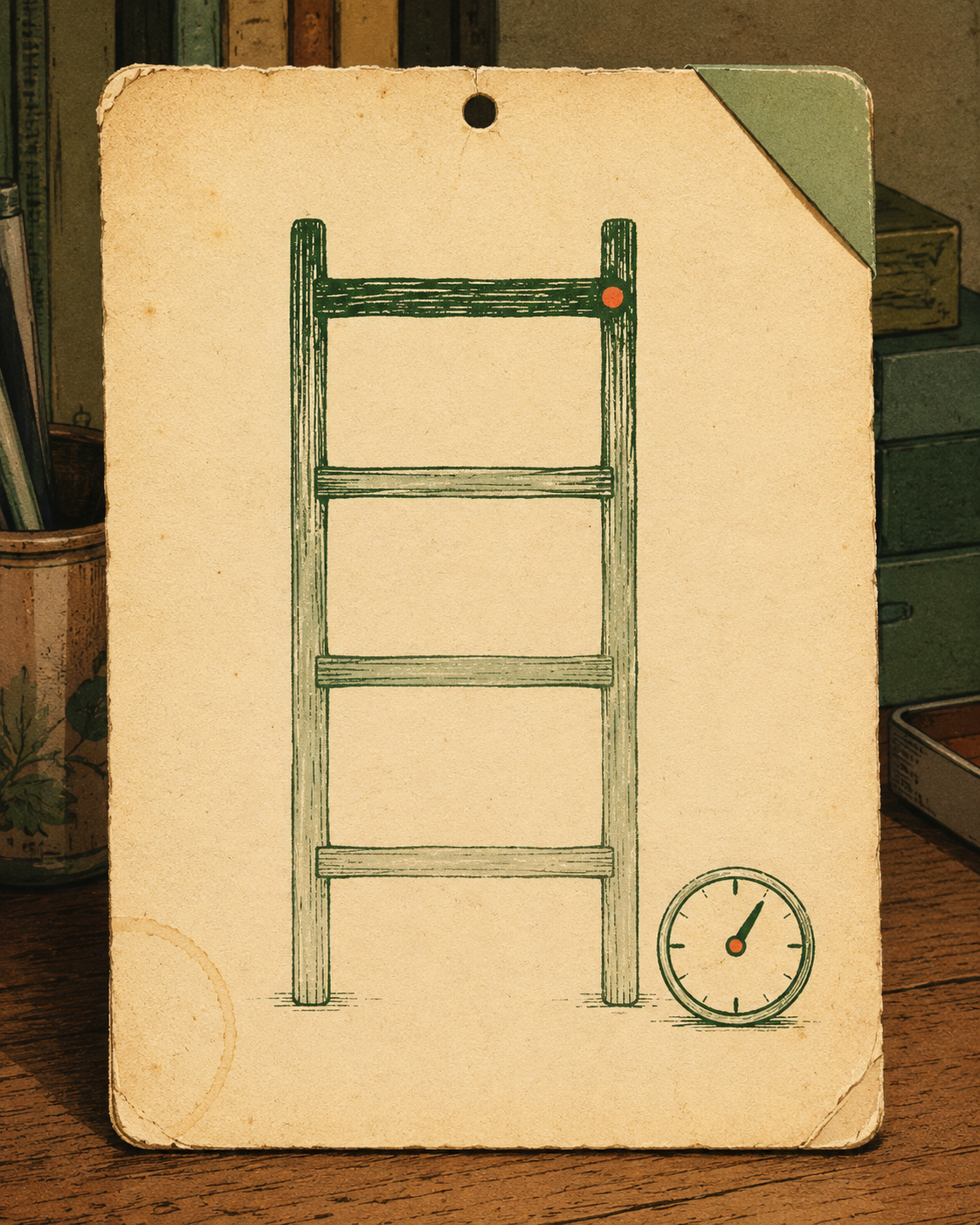
do this FIRST, while fresh
uncleared cards roll to tomorrow
Hardest, fresh, ~25 min → SRS on a 20-min timer → whatever's left, next-easiest.
"Just power through the reading after Anki — discipline." You can force yourself to open the book. You can't force your working memory back to full. The willpower and the attention are pulling from the same tank.
"Add fewer new cards." Good idea, genuinely. But it only slows how fast the queue grows — it doesn't change which task gets your peak hour today.
"Study longer." This one backfires. A longer session just adds more tired minutes to the back half, where — because reviews went first — your high-value task is stuck living. More time, spent in the wrong order, is just more time misspent.
See the pattern? Every one of those tweaks fiddles with how much Anki you do. None of them touches the thing that actually decides your progress. It was never the amount. It's the position.
Enjoying this? If someone forwarded you this issue, subscribe here so you don't miss next week's.
SubscribeThe Rule: Hardest Task First, Reviews on a Timer
Here's the whole thing in one breath. Do your hardest, most generative task first — while your tank is full. Then put your SRS on a hard timer so it can never expand to eat the session. Whatever you do second is where maintenance goes, not growth.
Three moves. That's it.
1. Rank your tasks by effort — for you, at your level. Before you open anything, name what's on tonight's menu and put it in order, hardest to easiest. For most intermediate learners it looks like this:
→ Intensive reading / new immersion — hardest. Continuous lookups, parsing, holding it all together.
→ Focused grammar with active recall — high.
→ Output / shadowing — medium (more on this in Level Up).
→ SRS review of mature cards — easiest. Fast retrieval of stuff you already know.
Call it the Effort Ladder. Your ladder might be shaped differently — the point isn't the exact list, it's that you rank your reality.
2. Do the top of the ladder first, in a protected block, before you touch any queue. This is where your fresh attention actually pays off. Harder, more generative work rewards the effort you put in — so it deserves your best minutes, not your leftovers. Give it a timer too (say 25 minutes) so it doesn't sprawl, but this is the block that gets the good you.
3. Then open your SRS and set a hard 20-minute cap. Review until it rings. When it rings, you stop — even mid-queue. Uncleared cards roll to tomorrow.
That timer is the load-bearing part of this whole issue, so don't skip past it.
An uncapped review queue isn't really a "task" — it's an open-ended pit that expands to swallow whatever energy you have (and then some). The cap is what converts it from a tax you pay off the top, in full, into a budget line you control.
And there's a one-line test that makes the whole thing automatic. Before any task, ask: can I do this well on a tired brain? If yes, it goes second. If no, it goes first. Mature-card review passes that test easily. First-pass intensive reading fails it every time.
Your session template, small enough to screenshot:
Hardest task, fresh, ~25 min → SRS on a 20-min timer → whatever's left goes to the next-easiest thing.
Pin that above your desk. That's the issue.
⬆️ Level up レベルアップ
Once your deck is mostly mature and you're barely adding new cards, this rule doesn't get weaker — it gets stronger. Your reviews are now almost pure upkeep, which makes them the perfect candidate for your tired, second-slot attention. (If SRS still somehow feels like your hardest task at that stage, treat it as a diagnostic: your cards are probably testing recognition you should've automatized by now, or the deck's bloated with stuff that belongs in your reading, not your flashcards.)
One refinement for the confusable stuff. When the challenge is telling near-identical things apart — grammar like 〜わけだ vs 〜はずだ, pitch-accent minimal pairs, look-alike kanji — don't block it into one long chunk. Mixing similar items up (interleaving) beats grinding them one at a time. So: hardest category first, but interleave the items inside it. (はずだ is a forward-looking expectation — "should be." わけだ is the retrospective click of "ah, so that's why." Not the same, and mixing them is exactly how you learn to feel the difference.)
Kanji of the Week: 順 📚
☕ Kanji of the Week
On'yomi: ジュン
Kun'yomi: (no common kun'yomi)
Meaning: order, sequence, turn, obedience
Key words: 順番 (order, one's turn) · 手順 (procedure, the steps in sequence) · 順調 (going smoothly, favorable)
Radical: 頁 ("big shell / head/page" radical) + 川 (river) on the left. A head, and flowing water.
Memory hint: Picture a river(川)that always flows in one direction, and a head(頁)deciding which way to face. Water never fights its own current — it goes in 順番, in order. Your study session wants to flow the same way: hardest first, downstream from there.
This week's connection: This whole issue is about 順番 — the order you do things in. Same tasks, same 90 minutes. Reorder them and the outcome changes. 順 is the variable nobody told you was the variable.
New to kanji readings?
Learn how on'yomi and kun'yomi work →Renshuu Time 練習 📝
For your next 5 study sessions, run The One-Week Reorder. No new tools — just a different order and a timer.
(No answer key on this one — it's your own session, your own ranking. Just run it and watch what happens.)
→ Starter: Reorder one session this week. Before you open anything, do your single hardest task first for 20 minutes. Then — and only then — open your SRS.
→ Standard: For 5 sessions: (1) rank tonight's tasks hardest-to-easiest before you open anything; (2) do the top one first in a protected ~25-min block; (3) open SRS on a hard 20-minute timer and stop when it rings, even mid-queue; (4) give whatever's left to the next-easiest task. Jot one line after each: did my hardest task get my best attention today?
→ Challenge: Run all 5, and at least once, let the 20-minute timer ring with cards still in the queue — and walk away anyway. Note what actually happened the next day. (Spoiler: the cards were fine. So were you.)
You'll know you did it when: five sessions in, the task you used to skip or half-do — the reading, the output — is the one getting your sharpest attention, and your reviews got done in a fixed box without eating your whole night.
When that 20-minute timer rings and cards remain, your brain will scream that stopping is irresponsible. That scream is the streak talking, not the learning. The uncleared cards roll to tomorrow. Stop anyway. The guilt you feel is just the old habit defending itself — and the first time you leave cards behind and nothing catches fire, the spell breaks a little.
Even reordering one session counts. You just pointed your best minutes at your highest-value work — maybe for the first time in months. You didn't need more time. You needed the good minutes aimed right.
Last week's rebuild (The Study Split Diagnostic): No answer key on that one either — the "right" split was always yours. But the pattern held: the skill people named as their #1 weakest was almost always the one they'd been quietly skipping (usually listening or output), while the comfortable skill — usually vocab — was eating the biggest block. If your anchor and your biggest block finally point at the same skill, you nailed it.
Tiny Win
You read this far, which means you already know something most learners at your level don't: the order is a variable, and it's yours to set. That single reordered hour this week is worth more than the whole perfect-streak month behind it. Give yourself that.
Further Reading (Optional)
If you suspect your session needs rotation and not just reordering, spend about ten minutes with Tofugu's piece on interleaving your Japanese — it makes the case for short, rotating study blocks and pairs neatly with this week's rule. We handle the macro order ("hardest first, reviews on a timer"); Tofugu shows how to rotate within your hard block for confusable material. Two layers of the same idea.
One Question, One Reply
Which one are you right now — "reviews-first" or "reading-first"?
Reply with just that one word. If you've been reviews-first, tell us what your hardest task actually is — the one that's been getting your leftovers. We read every reply, and naming it out loud is step one of pointing your best hour at it.
Stay connected

🎧 Catch us on the Kotoba Brew podcast — Japan through its language, one word at a time. Listen here →
Follow us: X / Twitter · Reddit
これからも一緒に頑張りましょうね〜 💪
Until next Thursday,
— Kotoba Brew Editorial Desk