

開く or 開ける? Here's the rule nobody gave you
Language Deep-Dive · Verbs · N3–N2
{{first_name | みんな}}さん、こんにちは ☕
You're typing in your journal app. You want to say "the door opened." You reach for the verb and freeze.
開く or 開ける? One of these means "the door opens by itself." The other means "I opened the door." You think for ten seconds, pick one, and feel a 30% chance you got it wrong. Next sentence — "I opened the door" — and you freeze again.
You've done this before. Probably a hundred times. And somewhere in the back of your head is the suspicion that there has to be a rule, and nobody gave it to you.
There is one. Today we hand it over.

The wall isn't you. It's how this was taught.
Here's the thing most textbooks get wrong about 自動詞 / 他動詞 pairs: they introduce them as two columns of vocabulary, hand you 50 pairs to memorize, and call it a chapter.
Genki shows you the labels. Tae Kim explains the concept (self-move vs other-move). Anki drills them as isolated cards. None of them tell you that most pairs follow predictable sound patterns — that the shape of the verb tells you which side of the pair it is, about 80–90% of the time.
So plateau fighters end up brute-force memorizing 開く / 開ける, 閉まる / 閉める, 始まる / 始める as separate vocabulary items. They pass the cards. They still guess in their own sentences.
The card was never the problem. The pattern under the cards was hidden.
The three patterns (covers ~80% of pairs)
There are three sound-shape patterns that decide most 自他 pairs. We'll call them the Three Patterns. Not laws — patterns. They cover roughly 80–90% of cases, and the rest you handle with one question. More on that in a minute.
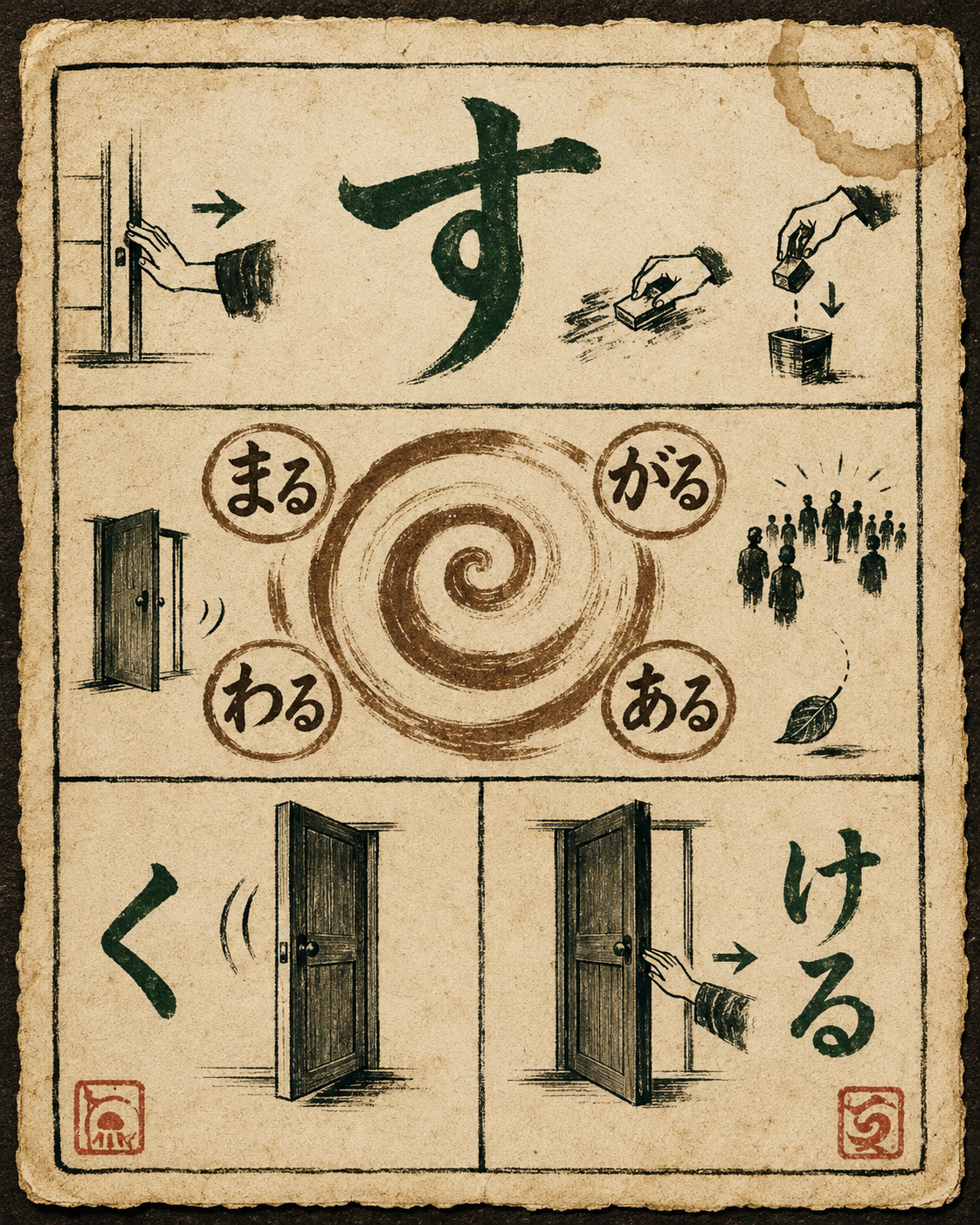
Pattern 1 — Ends in 〜す? It's transitive (他動詞).
Almost any verb ending in 〜す is 他動詞. Someone is doing it to something.
→ 出す — take out, put out
→ 消す — erase, turn off
→ 落とす — drop
→ 直す — fix
→ 起こす — wake up (someone)
Confidence: very high. There's basically no common counterexample at the level you're working at.
Pattern 2 — Ends in 〜まる / 〜がる / 〜わる / 〜ある? It's intransitive (自動詞).
Verbs that end in あ段 + る — that is, 〜まる, 〜がる, 〜わる, 〜ある, 〜かる — are almost always 自動詞. Something is changing on its own.
→ 始まる — [something] starts
→ 集まる — [people] gather
→ 閉まる — [door] closes
→ 上がる — [something] goes up
→ 変わる — [something] changes
Confidence: high — overwhelming for change-of-state verbs.
Pattern 3 — A 〜u / 〜eru pair? The 〜u is intransitive, the 〜eru is transitive.
When you see a verb pair where one form ends in plain 〜u and the other ends in 〜eru, the 〜u side is 自 and the 〜eru side is 他.
→ 開く / 開ける — [door] opens / [I] open [door]
→ 付く / 付ける — [light] turns on / [I] turn on [light]
→ 入る / 入れる — [something] enters / [I] put [something] in
Pattern 3 only applies to actual 〜u / 〜eru pairs. Don't generalize it to every verb ending in 〜eru. 焼く is transitive and 焼ける is intransitive: same shape, opposite assignment. 壊す / 壊れる flips it too. If a pair looks like 〜u/〜eru and feels like a change-of-state pair, Pattern 3 holds. If not, ask the fallback question instead.
The fallback: "What is changing?"
The patterns cover ~80%. The remaining 20% — irregular pairs, lexical exceptions, the ones that don't fit a shape — get handled by one question:
Who or what is changing state, and is something causing it?
→ If the thing changes on its own → 自動詞 + が
→ If an actor is causing the change → 他動詞 + を
落ちる — something falls (自). 落とす — someone drops something (他). 出る — something exits (自). 出す — someone takes something out (他). The question sorts them before you even look at the particle.
Before you internalize "を = transitive," look at 道を歩く. The classic plateau-fighter trap: "transitive verbs take を, intransitive verbs take が." Partly true. But を with motion verbs marks a path, not an object. 道を歩く (walk along the road). 空を飛ぶ (fly through the sky). 海を泳ぐ (swim through the sea). The verbs are still intransitive. を is doing different work. Pick the verb first using the patterns + the fallback question. The particle follows the verb, not the other way around.
Enjoying this? If someone forwarded you this issue, subscribe here so you don't miss next week's.
SubscribeThe twelve pairs that cover most of N4–N2
Screenshot this. The 12 highest-frequency 自他 pairs, sorted honestly by which pattern they fit.
| Group | 自動詞 (intransitive) | 他動詞 (transitive) | Meaning |
|---|---|---|---|
| 〜まる/〜める (Patterns 2+3) |
始まる | 始める | start |
| 集まる | 集める | gather | |
| 閉まる | 閉める | close | |
| 変わる | 変える | change | |
| Pattern 1 (〜す = transitive) |
出る | 出す | exit / take out |
| 落ちる | 落とす | fall / drop | |
| 起きる | 起こす | get up / wake (someone) | |
| 消える | 消す | disappear / erase | |
| 直る | 直す | get fixed / fix | |
| Pattern 3 (〜u / 〜eru) |
開く | 開ける | open |
| Lexical pair (use fallback) |
入る | 入れる | enter / put in |
That's it. Twelve pairs. Four groupings. You can pin this to your phone and reference it every time you write.
☕ If you don't have an Anki source for these yet, the free Jitsuryoku Kihon deck is built around exactly these high-frequency pairs. Start there.
The ている bridge (where this pays off)
Here's the part nobody mentions when they teach 自他: it solves your ている problem too.
We covered this from the ている side a few weeks back (the ている form: process or change?). From the 自他 side, it looks like this:
自動詞 + ている = resultant state
The situation exists as a result of a completed change
ドアが開いている
The door is open (currently in the state of having opened)
電気が付いている
The light is on
窓が割れている
The window is broken
他動詞 + ている = ongoing action
Someone is actively doing something right now
ドアを開けている
Someone is opening it right now, mid-motion
Same kanji compound, different verb, different reading of ている. The rule that decides which one is the same rule that decides 自他 in the first place.
You just solved two grammar points with one rule. ✨ Every time you sort the verb correctly, the ている form sorts itself.
(Stative verbs like 知っている, 持っている, 住んでいる, 結婚している don't follow the action/state split — with these, ている reads as a state regardless of the verb's transitivity. You already use them right intuitively. Move on.)
Level up レベルアップ
Three things worth knowing if the core landed clean.
⬆️ Level up
1. The other 開く is a double-agent verb. 開く has a second reading, 開く, and ひらく is a 自他同形動詞 (a verb whose transitive and intransitive forms are identical). 花が開く = the flower opens (intransitive). 店を開く = open a shop (transitive). Same form, both jobs.
This is NOT the same verb as the あく / 開ける pair you just learned. あく is intransitive-only. ひらく is the genuine double-duty one. The transitivity split runs along the reading, not the kanji. About a dozen 自他同形 verbs exist; you learn them as exceptions, not as a pattern.
2. The 〜てある construction is the third path. ドアが開けてある = "the door has been opened (and left in that state) intentionally, by someone." 〜てある attaches to a transitive verb + が (not を), and it carries the implication that someone left things this way on purpose. テーブルに料理が並べてある = the food has been laid out on the table. Critically: ドアが開いてある is ungrammatical. 〜てある never attaches to an intransitive verb. So you now have three distinct constructions to keep separate: 自動詞+ている (resultant state), 他動詞+ている (ongoing action), 他動詞+てある (intentional resultant state). They are not a gradient. They are three different tools.
3. The 受け身 substitution. ドアが開けられている (passive of 開ける + ている) is grammatical and can describe a state, but it carries a formal, agent-salient nuance, often hinting at intrusion or reportage. For a neutral "the door is open," natives prefer the intransitive. Rule of thumb: if you'd happily skip the agent in English, use 自動詞. If you'd hint at one, use the passive.
Tofugu's full transitivity guide goes deeper on the 自他同形 list and edge cases if you want a Saturday read.
Kanji of the Week: 開 📚

☕ Kanji of the Week
On'yomi: カイ
Kun'yomi: あ・く / あ・ける / ひら・く
Meaning: Open. Begin. Unfold.
Key words: 開店 (store opening) · 開始 (start, commencement) · 開く (to open, double-duty) · 開く (to open, intransitive)
Radical: 門 (gate) + 开 (two hands lifting a bar). Picture two hands lifting the wooden crossbar off a closed gate — the gate opens.
Memory hint: A gate (門) with someone's hands underneath, hoisting the bar. The moment a shop unlocks its doors for the morning. That's 開.
This week's connection: The 開 family is the perfect kanji to anchor today's lesson. 開く is the intransitive — the door opening on its own. 開ける is the transitive — you opening it. 開く is the same-form double-agent we covered in Level Up. One kanji, three readings, three jobs, and now you know which is which.
New to kanji readings? Learn how on'yomi and kun'yomi work →
For more high-frequency kanji like 開, drilled with example words and readings: the Jitsuryoku Kanji Kihon deck is free and built for exactly this layer.
Renshuu Time 練習 📝
The Five-Pair Output Test — about 15 minutes.
Pick 5 verb pairs from your SRS deck, sentence-mining batch, or recent reading. (No source? Use these: 開く / 開ける, 始まる / 始める, 付く / 付ける, 落ちる / 落とす, 入る / 入れる.)
For each pair, write two sentences in your journal app or on paper:
1. One using the intransitive + ている (resultant state). Example: 「窓が開いている。」
2. One using the transitive + non-ている (action). Example: 「窓を開けた。」
Ten sentences total. Tomorrow, read them again without looking at this issue.
(No answer key this week — this is production practice, not a quiz. The next brew will share what readers reported back.)
→ Starter: 3 pairs, 6 sentences. Pick the easiest 3 from the list above.
→ Standard: 5 pairs, 10 sentences. The intended task.
→ Challenge: 5 pairs, 10 sentences — AND add a third sentence per pair using 他動詞 + 〜てある (intentional resultant state). 15 sentences total.
You'll know you did it when: the day after, at least 8 out of 10 sentences feel automatic — the verb pick happened without a deliberate pause.
Even if you only wrote 3 pairs and not 5, you trained the selection skill — which is the one that fails in real output. Six sentences of selection practice beats sixty Anki card reviews of recognition practice. ✨
⬆️ Level up (optional)
For each of your 5 pairs, also write the 受け身 version (e.g., ドアが開けられている) and notice when it feels right vs. when the plain intransitive is cleaner.
Last week's answers (The 6-Week JLPT Final-Push Plan): Reader replies clustered around three error patterns: pacing on long reading, register misses on near-identical grammar choices, and vocab you thought you knew. If reading was your weakest, you're in the median. If you dropped Anki new-cards to make room for post-mortem time — that's the right move.
Tiny Win
If you're at the level where 自他 pairs trip you up, you're not behind. You hit the exact wall every plateau fighter hits — because the rule was hidden under a pile of vocabulary, not because you're slow. The wall was always going to be here. Today it has a door in it.
One thing to do this week
Reply with one word: stuck or cruising.
→ stuck — you'd still hesitate on 開く vs 開ける in a journal entry. We'll send you the deck and the ている piece together so the pattern locks in.
→ cruising — you sorted the 12 pairs in your head while reading. Drop the Renshuu output and we'll feature the cleanest ones next week.
Either reply gets you the same thing: a real human reading your sentence and telling you what's working.
これからも一緒に頑張りましょうね〜 💪
Stay connected

🎧 Catch us on the Kotoba Brew podcast — Japan through its language, one word at a time. Listen here →
Follow us: X / Twitter · Reddit
Until next week,
— Kotoba Brew Editorial Desk