

The Intermediate Plateau: Why It Feels Like Quicksand
Mindset & Community
{{first_name | みんな}}さん、こんにちは ☕

Six months ago, every study session had fireworks. A new kanji clicked. A sentence you couldn't read last week suddenly made sense. You were on fire.
Now you finish a two-hour session and it feels like you can't name a single thing you learned.
Not one thing.
The fireworks stopped. But something else changed first. And it wasn't your ability.
The Measuring Stick Broke, Not You
Here's the pattern we keep seeing: someone finishes their beginner materials, starts handling basic conversations, reads their first manga without a dictionary on every page. Progress is visible. Tangible. Almost addictive.
Then intermediate hits. And the feeling changes.
"After 4 years I'm still stuck. Motivation dying." That's a real post from r/LearnJapanese with 500+ upvotes. And from the WaniKani forums: "I don't improve anymore and I honestly don't know how."
Sound familiar? Good. Because the problem isn't you.
The intermediate plateau is structural. It's built into how languages work.
Think of it like a jigsaw puzzle. At the beginner stage, you're placing corner pieces and edges —fast, obvious, satisfying. Every piece clicks into place and you can SEE the frame taking shape.
At intermediate, you're working on the sky. Hundreds of blue pieces that all look the same. You're placing pieces every single session. But the picture doesn't look any different from yesterday.
The pieces are going in. The picture IS forming. You just can't see it from this close.
We spent three months in this exact fog. Kept opening our SRS app, doing 200 reviews, closing it, and thinking "what did I even learn today?" One night we went back and re-read an NHK Easy article from four months earlier. Read it in half the time. Looked up zero words. The progress had been there the whole time —we just didn't have a way to see it.
That's the real problem. Not missing progress. Missing evidence.
Free Anki Deck for This Stage
We just published new Anki decks designed specifically for this stage (intermediate → advanced). If you want the simplest next step after today's audit, start here.
Why the Fireworks Stop (The Math Nobody Explains)
Most plateau advice treats this as a motivation problem. "Just keep studying." "Find something you enjoy." "Don't give up!"
That's like telling someone lost in fog to just keep walking. Direction matters.
Here's what's actually happening.
At the beginner stage, roughly 150-200 grammar points cover the entire system. Learning て-form unlocks requests (教えてください), sequential actions (食べて寝た), and ongoing states (待っている) —three entire communication functions from one grammar point. Each new piece represents a huge percentage of your total knowledge. It FEELS massive because it IS massive.
At intermediate, you're adding 200+ more grammar points. But now each point is a smaller slice of a bigger pie. Learning ~ようにする adds one nuance to one type of sentence: expressing effort toward a goal (日本語が話せるようにする). Same effort. Smaller-seeming reward.
Vocabulary tells the same story. Intermediate requires roughly 3,750-6,000 words —a massive jump, mostly into abstract and formal territory. Each new word contributes less visible improvement because it's a tinier percentage of what you already know.
The fireworks stopped because the ratio changed. Not because you stopped learning.
(If you use JLPT as a reference, this maps roughly to the post-N4 through mid-N2 stretch —but you don't need to be a JLPT test-taker to feel this. Anyone who's passed the beginner stage hits this wall.)
The Law of Diminishing Returns (and Why It's Not Bad News)
Here's a way to make the math click.
When you knew 50 grammar points, learning one new one was a 2% jump in total knowledge. You could FEEL that. When you know 300 grammar points, one more is a 0.3% jump. Same effort per point. But the visible return shrinks as the base grows.
This is the law of diminishing returns —and it's not unique to Japanese. It shows up in every skill humans learn. Weight lifters call it "newbie gains." Musicians know the first year sounds like a miracle and the fifth year sounds like incremental refinement. Language acquisition researchers Lightbown and Spada document this as a predictable "consolidation phase" where perceived progress flatlines while actual restructuring happens underneath.
The crucial part: diminishing returns on visible progress does not mean diminishing returns on actual learning. You're still adding pieces. The puzzle is still forming. The signal-to-noise ratio just shifted —and your old measuring tools can't detect the signal anymore.
The fix isn't "more motivation." It's better measurement.
"I should be further along by now." Compared to what? That timeline? Written by a beginner who had no idea what intermediate terrain looks like. Comparing your beginner pace to your intermediate pace is like comparing walking speed on flat ground to walking speed uphill. Same legs. Different terrain. And those "fluent in 18 months" posts on Reddit? That's either a heritage speaker, someone studying full-time in Japan, or someone measuring "fluent" very generously.
We call this stretch the Fog Zone —the territory between beginner confidence and intermediate competence where daily progress is real but invisible. Here's what it actually sounds like from learners who've been there:
"I do 200 reviews every morning and feel nothing. Like pouring water into sand." That's from a WaniKani thread with dozens of people nodding along. Or this, from r/LearnJapanese: "I used to read manga for fun. Now I open a volume and it feels like homework. I know more words than I did a year ago but somehow reading feels harder."
That second one stings because it's backwards, right? More knowledge, worse experience. But it makes sense: at beginner level, you were reading material calibrated to your level. At intermediate, you're reaching for real content —and the gap between "what you know" and "what the text demands" is wider. You're not worse. Your standards upgraded.
Everyone who reaches conversational fluency passed through the Fog Zone. Most of them thought about quitting. The ones who made it through didn't have more talent. They had better evidence that it was working.
So if the progress is real but invisible —can you force it to show itself?
Yes. That's what the Progress Audit does.
Enjoying this? If someone forwarded you this issue, subscribe here so you don't miss next week's.
SubscribeThe Progress Audit: 3 Tests That Make Invisible Growth Visible

Stop trusting the process. Start measuring it. Here are three tests you can run monthly —each takes 5-10 minutes and generates a concrete data point.
Test 1: The Time Machine Read. Find something you read 3 months ago —an NHK Easy article, a manga chapter, a textbook passage. Read it again. Time yourself. Count lookups. You WILL be faster. You WILL look up fewer words. That delta is your progress.
Sample numbers: a typical intermediate learner sees something like 12:30 + 18 lookups → 8:10 + 6 lookups over 3 months. Even a smaller shift —2 minutes faster, 4 fewer lookups —is real, compounding growth.
Test 2: The Listening Replay. Remember that podcast episode from 3 months ago? The one where you caught maybe half? Listen to the first 5 minutes again. Rate your comprehension as a percentage. Going from 40% → 55% doesn't sound dramatic. It is. That's three months of your brain building connections you couldn't see. (Trust us —the surprise on this one hits hard.)
Test 3: The Production Timer. Pick a topic —your weekend, your commute, your opinion on a food. Set a 2-minute timer. Write or speak as many sentences in Japanese as you can. Save it. Do it again next month. Track two things: sentence count (5 → 8 is typical) and connector variety —are you using でも、なので、一方で, or just stringing sentences together?
Why this works: The plateau isn't that you stopped improving. It's that daily improvement is too small to notice in real time. These tests compress 3 months of micro-gains into one visible delta.
In our "Your Progress Is Invisible" edition, we introduced the idea that growth happens in ways test scores can't capture. Today we go deeper: why the 停滞 exists, why it's structural, and how to measure through it.
⬆️ Level up
At advanced levels, the plateau shapeshifts into the nuance wall. You can communicate. You can read novels. You can follow NHK news. But the gap between "functional" and "natural" is enormous —and almost entirely invisible from the outside.
Progress markers become things only you can detect: choosing ところ over 場合 by feel, hearing the difference between 一応 and とりあえず, knowing when ~ではないでしょうか is genuinely polite vs. passive-aggressive.
Add a fourth test to your audit: The Nuance Journal. Keep a running note on your phone. Every time you notice a distinction you wouldn't have caught 3 months ago —a register choice, a word pair, a grammar nuance —write it down. Count the entries at month's end. That number IS your progress.
Kanji of the Week
☕ Kanji of the Week
On'yomi: ヘキ
Kun'yomi: かべ
Meaning: Wall, barrier
Key words: 壁 (wall) ・ 壁にぶつかる (to hit a wall) ・ 言葉の壁 (language barrier)
Related: 乗り越える (to overcome, to get over)
Radical: 土 (earth) + 辟 (phonetic component)
Memory hint: A wall made of earth —it feels solid and permanent, but earth walls crumble over time. So does the intermediate plateau.
This week's connection: The entire issue is about the 壁 between where you are and where you're headed. 壁にぶつかる is exactly what you're experiencing. The Progress Audit is your tool for proving the wall is crumbling, even when it doesn't look like it.
New to kanji readings? Onyomi, kunyomi, and all those symbols above —we explain it all.
How Readings Work →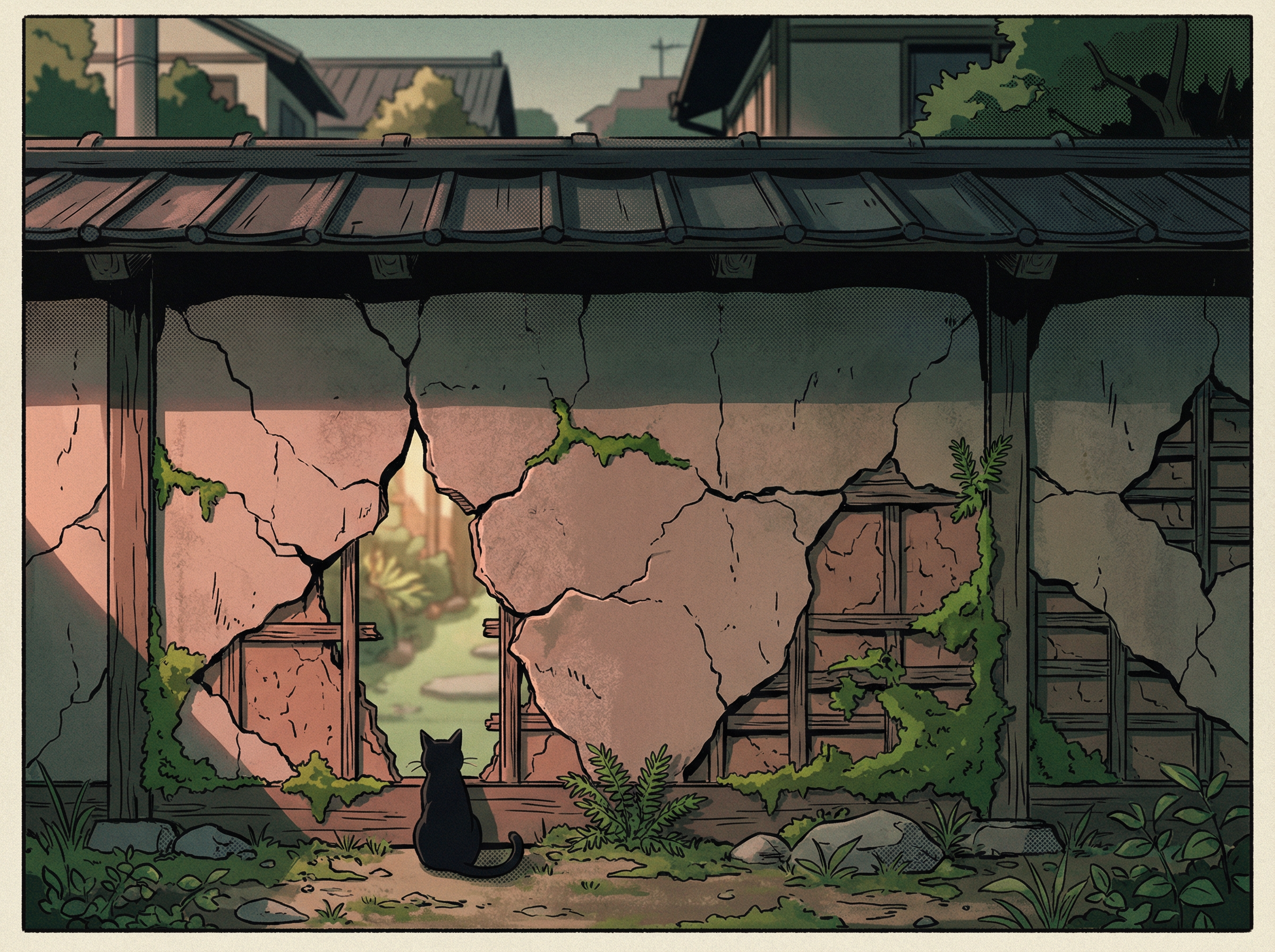
Renshuu Time 練習 📝
Run your first Progress Audit. Pick ONE of the three tests and do it this week. Not all three —one.
(Answers drop in next week's brew —try running the test first!)
Starter: Run Test 1 (Time Machine Read) only. Open your browser history or NHK Easy bookmarks right now. Pick any article from ~90 days ago. Set a 10-minute timer. Go. Note how it feels compared to the first time. Write one sentence about the difference.
Standard: Run all three tests this week. Save the results somewhere you'll find them next month. Set a calendar reminder for "Progress Audit" 30 days from now.
Challenge: Run all three tests, then write a 3-sentence reflection in Japanese about what surprised you. Reply to this email with it —we read every single one.
You'll know you did it when: You have a concrete data point —a time, a percentage, a word count —that you can compare next month.
The number doesn't matter. Having it does.
If you ran even one test and found any difference —30 seconds faster, 2 fewer lookups, one extra sentence —that's not "a little progress." That's your brain building pathways you can't see. The test didn't create the progress. It revealed what was already there. ✨
Last week's answers:
Last week we asked you to diagnose your top 5 leech cards: Ghost (no memory trace), Evil Twin (confused with a similar word), or Wrong Shape (card design problem). There's no single right answer —your leeches are yours.
But here's the pattern: Ghosts come from word lists without context. Evil Twins come from near-synonyms or same-reading pairs. Wrong Shapes come from cards testing too many things at once. If you diagnosed even one card differently than "I'm bad at this," you're already thinking like someone who fixes problems instead of blaming their memory.

If you read this far, you already understand something most intermediate learners never hear: the plateau is structural, not personal. That understanding alone changes how you study. You're not lost. You're in the Fog Zone. And you're closer to the other side than you think.
One more thing. The Fog Zone doesn't only happen once. You'll re-enter it at advanced levels —when the nuance wall replaces the vocabulary wall. The skill you're building right now isn't "grind." It's measurement and course-correction. That skill travels with you through every stage of this language.
📚 Further Reading
For: Intermediate learners who want the research behind why plateaus happen
Use: Read the overview (15 minutes) and note the "restructuring" concept —it maps directly to what you're feeling
Why it helps: Lightbown & Spada's How Languages Are Learned is the academic gold standard on why acquisition isn't linear. The "consolidation phase" they describe IS the Fog Zone. For a free, shorter take on why skill gains slow down predictably, this overview of the power law of practice explains the same curve in plain language.
Reply with your delta. Seriously. "-3 lookups." "+2 min faster." "55% comprehension." Whatever your Progress Audit test showed you this week —we want to hear it. Every reply helps us write better issues for people at your exact stage.
Stay connected

🎧 Catch us on the Kotoba Brew podcast — Japan through its language, one word at a time. Listen here →
Follow us: X / Twitter · Reddit
これからも一緒に頑張りましょうね〜 💪
— Kotoba Brew Editorial Desk