

The Feelings Family
気持ち・気分・機嫌・感じ
{{first_name | みんな}}さん、こんにちは ☕
You feel a little off in a meeting, so you excuse yourself with the "feeling bad" phrase you're pretty sure you've heard a hundred times.
And your coworker's face does a thing.
Because you meant "I'm having an off day" — but what landed was closer to "I'm about to throw up," or worse, "you are disgusting."
Four Japanese words all translate to some flavor of "feeling." You know all four. That's not the problem. The problem is nobody ever gave you a rule for choosing between them at the moment you actually open your mouth.
If picking the right "feeling" word finally clicks for you here, it'll click for someone you know too. Subscribe or share →

You Don't Have a Vocabulary Problem. You Have a Sorting Problem.
Here's what most resources do with 気持ち, 気分, 機嫌, and 感じ.
They line them up, gloss each one — "feeling," "mood," "feeling," "feeling" — and call it a day.
Which is useless. Because now you're holding four words with nearly identical English definitions and zero way to tell them apart when it counts. So you default to one (usually 気分 or 気持ち), use it for everything, and hope.
We've watched learners do this at N1. This isn't a beginner gap. It's a late-stage one — which means if you're hitting it, you're further along than you think.
So we're going to skip the four definitions entirely. They don't help you choose.
Instead, ask one question: feeling about WHAT?
→ A bodily or sensory reaction → 気持ち
→ Your overall state right now → 気分
→ Someone's visible mood or temper → 機嫌
→ The vibe or impression of a thing → 感じ
That's the whole engine. Stop asking "which word means feeling" (unanswerable) and start asking "feeling about what" (answerable in one beat).
One caveat before we go deeper, because we'd rather you hear it from us than get "well, actually"-ed on Reddit: this is the clean default that gets you 90% of the way there. Real native usage has some blur at the edges — we'll show you exactly where. But the rule holds where it matters most.
Minimal Pair: The One That Changes the Room
Same English. Completely different world.
気持ちが悪い
"I feel sick / this is gross / that's creepy."
気分が悪い
"I feel unwell overall — or I'm upset / offended."
The difference: 気持ちが悪い points at a bodily, sensory reaction — nausea, disgust, the crawl you get looking at something creepy. 気分が悪い points at your overall state, and it's the one that covers emotional bad mood.
So when you want to say "I'm not feeling great, I need to step out," reach for 気分が悪い. It's the safe, non-alarming choice.
Say 気持ちが悪い in that moment and you've told the room you might be sick right here — or, if they read it as being aimed at a person or thing, that something is gross.
Enjoying this? If someone forwarded you this issue, subscribe here so you don't miss next week's.
SubscribeThe Deep Dive: Sort by the Target, Not the Translation
Let's run each word through the one question — feeling about what? — with enough examples to make the pattern stick.
気持ち — a reaction to something (body or heart).
This is the feeling caused by a trigger, or aimed at one. A massage. A breeze. A snake.
マッサージは気持ちいい。
"A massage feels good." (direct pleasant sensation)
ヘビは気持ち悪い。
"Snakes are gross / creepy." (direct unpleasant reaction)
お気持ち、ありがとうございます。
"Thank you for your kind feelings." (heartfelt intention)
In casual speech, people drop the が — 気持ちいい, 気持ち悪い. Written or careful speech keeps it: 気持ちが良い, 気持ちが悪い. Both are fine. Don't let the missing が throw you.
気分 — your overall state right now.
Diffuse. Changeable. Not pinned to one specific trigger. It's the weather system, not the lightning bolt.
部屋を片付けたから気分がいい。
"I cleaned my room, so I feel good." (気分がいい is the natural pick for overall mood; 気持ちいい would foreground a pleasant sensation instead — less prototypical here, not wrong.)
今日は気分が乗らない。
"I'm not in the mood today."
気分転換に散歩する。
"Take a walk for a change of pace / mood."
機嫌 — someone's visible mood, with social stakes.
This one you observe, usually in another person, and it carries consequences — you read the boss's 機嫌 before you ask for a favor.
今日は社長の機嫌がいい。
"The boss is in a good mood today." (i.e., safe to approach)
機嫌を取る
"to get on someone's good side / smooth them over."
機嫌が悪いから、そっとしておこう。
"They're in a bad mood, let's leave them be."
Kanji trap incoming: 機嫌 is written with 機 (the machine 機, same as 機械) — not 気. After a whole issue of 気 this and 気 that, your hand is going to want to write ×気嫌. It's such a common miswrite that dictionaries flag it. More on this in Kanji of the Week.
感じ — the vibe of a thing, not you.
This is the sneaky one, and honestly the easiest once it clicks. 感じ isn't about your internal state at all. It's the impression a thing or situation gives off.
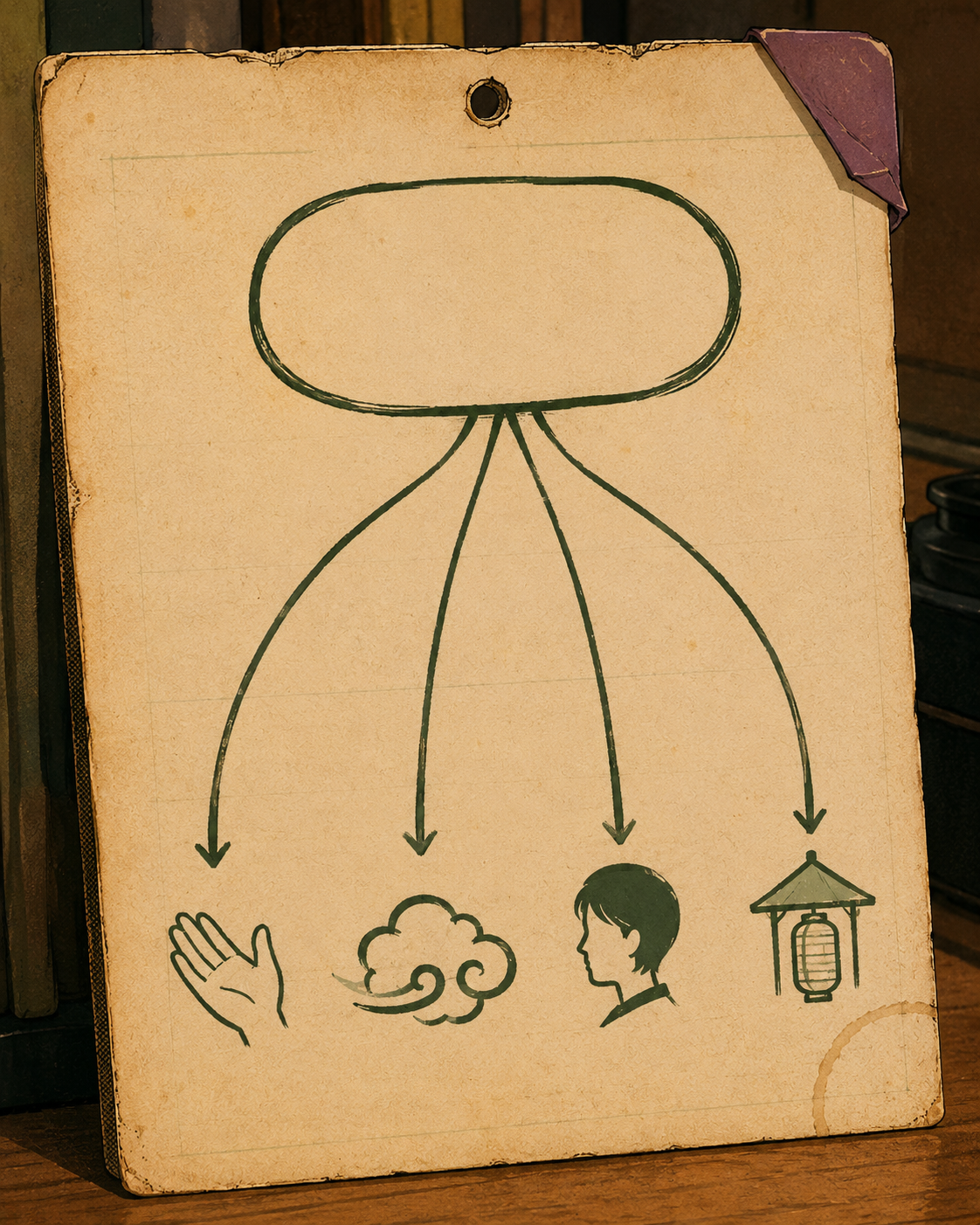
the open hand — a bodily / sensory reaction → 気持ち
the cloud — your overall state right now → 気分
the face — someone's visible mood → 機嫌 (written with 機, the machine — not 気)
the little lantern — the vibe of a thing → 感じ
One question. Four answers. Stop asking "which word means feeling." The clean default — 90% of the way there.
ここ、すごくいい感じだね。
"This place has a really nice vibe." (× いい気分 / × いい気持ち for a place's atmosphere)
そんな感じ。
"Something like that / that kind of feel."
いい感じのお店。
"A nice-feeling shop."
Swap in 気分 or 気持ち for a place's atmosphere and it just sounds off — those are about you, and a café doesn't have a mood, it has a vibe.
Now — the edges we promised. Here's where the clean split gets blurry, and knowing this is what keeps you from over-trusting the rule:
→ Physical sickness: both 気持ちが悪い and 気分が悪い actually work. For bodily discomfort the difference is focus, not right-vs-wrong. 気持ちが悪い foregrounds the stomach and nausea; 気分が悪い is the broader "I'm unwell" — and it can include nausea too. So 気持ちが悪い for feeling physically sick isn't an error; it just skews toward "I might vomit." The genuine meaning-swap — the socially loaded one — happens only in the emotional case below.
→ 気持ち can describe an overall state, not only a reaction to something. いい気持ちでいる ("to be in a good state of mind") is real. 気分 is just the default for diffuse mood; 気持ち isn't walled off from it.
→ 機嫌 isn't only about other people anymore. The old textbook line is "someone else's mood," and that's still the best first approximation. But 自分の機嫌をとる — "manage your own mood / keep yourself in good spirits" — is a very common modern phrase. So no, 機嫌 isn't strictly not-yours. (Hold that thought — it powers the Level Up.)
The one that actually derails a conversation. When you're emotionally upset — annoyed, in a bad mood, offended — do not say 気持ちが悪い.
❌ (upset at a meeting) 気持ちが悪い → heard as "I'm nauseous" or "you/this is gross." Never "I'm in a bad mood."
✅ 気分が悪い → "I'm feeling unwell / I'm upset." Safe.
✅ 機嫌が悪い → "I'm in a bad temper." (describing the visible mood)
For emotional bad mood, it's 気分が悪い or 機嫌が悪い — essentially never 気持ちが悪い. That one's a clean rule, and it's the one that saves you a genuinely awkward moment.
We'll be honest: we got this backwards ourselves for longer than we'd like to admit — defaulting to 気持ち for every bad feeling because it was the first "feeling" word we learned, and quietly telling people we were "gross" when we just meant we were having a rough day. Nobody corrects you on it, which is the cruel part.
Quick reference — screenshot this:
→ 気持ち → reaction to something (massage, snake, kindness). Feeling about a trigger.
→ 気分 → overall state right now (refreshed, off, not-in-the-mood). Feeling in general.
→ 機嫌 → visible mood, usually someone else's, social stakes. Feeling you read.
→ 感じ → the vibe of a thing or place. Feeling of an it, not a you.
Emergency rule: emotionally upset = 気分/機嫌, never 気持ち.
⬆️ Level up レベルアップ
The two you weren't guessing wrong — 機嫌 and 感じ — are the ones that quietly make you sound native. Here's the stance layer.
感じ as a hedge. Colloquial 〜な感じ / 〜って感じ lets you assert without asserting — it softens a claim into an impression. 「難しい感じ」lands softer than 「難しい」. You're saying "it comes across as hard" rather than declaring it. That's register control, not vocabulary.
機嫌 as something you cultivate. Remember 自分の機嫌をとる? There's a whole contemporary self-care current around it — ご機嫌 as a state you actively make, not one that happens to you (you'll see ご機嫌ルーティーン everywhere). It frames mood as something you have agency over — a small culture-meets-language window with no clean English equivalent.
One collocation note: 気分が乗らない is the set phrase for "not in the mood." 気持ちが乗らない gets heard far less and sounds slightly off to most ears — not wrong, just not the idiom. The collocation decides, not the gloss.
Kanji of the Week: 機 📚
☕ Kanji of the Week
On'yomi: キ
Kun'yomi: はた
Meaning: machine; mechanism; opportunity; the pivotal moment when something turns
Key words: 機嫌 (mood, temper) · 機械 (machine) · 機会 (opportunity, chance)
Radical: 木 (tree/wood) on the left + 幾 (how many / the subtle turning point) on the right. Wood shaped into a working mechanism.
Memory hint: Picture an old wooden loom — 木 + a delicate turning mechanism. A machine, yes, but also the exact moment the shuttle turns. That "pivotal turn" sense is why 機 shows up in 機会 (opportunity) and 機嫌 (which way someone's mood has turned today).

This week's connection: This is the kanji trap of the whole issue. 機嫌 uses 機 (machine), not 気 (spirit/feeling) — even though every other word this week is a 気 word. ×気嫌 is a genuinely common miswrite (dictionaries flag it as irregular). After 気持ち, 気分, and a screen full of 気, your muscle memory will fight you here. When you write "mood/temper," stop and reach for the machine 機. Someone's 機嫌 is the little mechanism of their mood — which way it's turned today.
New to kanji readings?
Learn how on'yomi and kun'yomi work →Renshuu Time 練習 📝
The "Feeling About What?" sort. Pull 8–10 real sentences with 気持ち / 気分 / 機嫌 / 感じ from stuff you already consume — your SRS examples, a manga page, a subtitle file, a podcast transcript. Cover the feeling-word, ask feeling about what?, and predict which of the four it should be before you reveal the original. Tally your hits.
(Answers drop in next week's brew — try sorting yours first!)
→ Starter: Just find 3 sentences and predict them. Even three reps trains the question.
→ Standard: 8–10 sentences from your own material. Cover, ask feeling about what?, predict, reveal, tally.
→ Challenge: For each one you nail, say why out loud — "reaction to a trigger, so 気持ち" — and flag any sentence where two words could genuinely both work (those are the fuzzy edges — spotting them is the advanced skill).
You'll know you did it when: you can look at a sentence, ask one question, and predict the right word on at least 7 of 10 before checking — and nail the 気持ちが悪い / 気分が悪い difference every single time.
Even if you only got the 気持ち悪い vs 気分が悪い pair right, that's the one that actually stops a real conversation from going sideways. That alone was worth ten minutes.
⬆️ Level up レベルアップ (optional)
Add 感じ-as-hedge to the hunt. Find one 〜な感じ / 〜って感じ in the wild and rewrite the sentence without it — feel how much blunter it gets.
Last week's reorder (The Order You Study In): No key on this one — the "right" order was always yours. But the pattern held: almost everyone who ran it found the same thing. Their hardest task (usually reading or output) had been quietly getting their most-fatigued attention, and their SRS had been eating the fresh hour it never needed. If you stopped mid-queue when the timer rang at least once and nothing bad happened — that's the whole win. The uncleared cards rolled to tomorrow, like they always would.
Tiny Win
If you made it this far, you can now do something most learners at your level can't: choose a "feeling" word on purpose instead of guessing.
That off day in the meeting? You've got the safe word for it now — 気分が悪い — and you know why the other one would've made it weird. Small thing. Real thing.
Further Reading (Optional)
For: N3–N2 learners who want to hear the difference, not just read it.
Use: Next time a Japanese podcast, drama, or YouTube video you already watch uses one of these four words, rewind ten seconds and ask feeling about what? before you check the subtitle. Two minutes, no new tool.
Why it helps: These words carry tone and body language that a definition can't. Catching them in real audio — where the speaker's face and situation tell you the "about what" — welds the rule to real input instead of a flashcard.
Reply With One Word
Which one has been tripping you up most — 気持ち, 気分, 機嫌, or 感じ?
One word back, that's it. We read every reply, and it tells us exactly where to aim the next deep-dive. Even naming it out loud starts fixing it.
Stay connected

🎧 Catch us on the Kotoba Brew podcast — Japan through its language, one word at a time. Listen here →
Follow us: X / Twitter · Reddit
これからも一緒に頑張りましょうね〜 💪
Until next Thursday,
— Kotoba Brew Editorial Desk