
You're not learning the word. You're learning the picture.
When flashcard images help, when they hurt, and how to tell the difference
{{first_name | みんな}}さん、こんにちは
Some folks swear by slapping images on every flashcard. Others ditch them completely. Both sides are kinda missing the point.
You should be using images. Not because they're trendy—because they actually work. When you pair a word with a clear, meaningful image, your brain builds dual pathways—verbal and visual—both leading to the same concept. Research shows this gets you faster recall and better retention. One study on vocabulary learning found that learners using specific, meaningful images alongside words retained 30-40% more vocabulary over time compared to text-only methods.
So yeah—use images. But here's where most people mess up.
What separates an image that speeds up your learning from one that's quietly messing things up? It's not WHETHER you use images—it's which images actually clarify the concept.
This week, we'll hit the test that shows if your images are pulling their weight—and a way to make them actually do the job.
When images backfire (and you don't even notice)
When an image helps, it creates a clear, direct connection to the concept. You see 食べる, the image of eating comes to mind (whether it's a ramen pic on your card or a mental image), and boom—"to eat." Clean path.
Whether the image comes to mind first or the word triggers it doesn't matter. Both routes lead you to the same meaning. That's dual coding working correctly—two pathways, same destination.
But when it hurts? The image is vague, generic, or could mean multiple things. You see 努力 with a stock photo of a businessman climbing a mountain. Your brain recalls: "That card with the climbing guy... was it effort? Or perseverance? Or challenge?"
The image doesn't clarify—it creates ambiguity.
Here's the real kicker: The trap isn't using images to recall words. The trap is using images that don't actually represent the specific concept you're learning.
Out in real Japanese—reading, listening, speaking—the meaning needs to be clear. If your flashcard image is doing the job of clarifying the concept (whether concrete or emotional), that's exactly what you want. If it's just decorative noise that could mean five different things, it's interference.
Research on abstract word learning shows they're grounded in emotional experience, not pure visual description. For abstract words especially, personal emotional connections aren't bypassing the word—they're creating the clearest possible pathway to the concept.
The real trap isn't image-to-word recall. It's ambiguous images that create recognition shortcuts to the wrong concept, or to nothing specific at all. If your image clearly represents the meaning (concrete or emotional), you're using dual coding correctly—whether the image fires first or second.
When images actually help
Look, images aren't the bad guy here. Get them right, and they can really push things forward.
There's this thing called dual coding theory (from Allan Paivio)—your brain handles words and visuals on different tracks. When both lock onto the same idea, you've got double the retrieval pathways to pull it back.
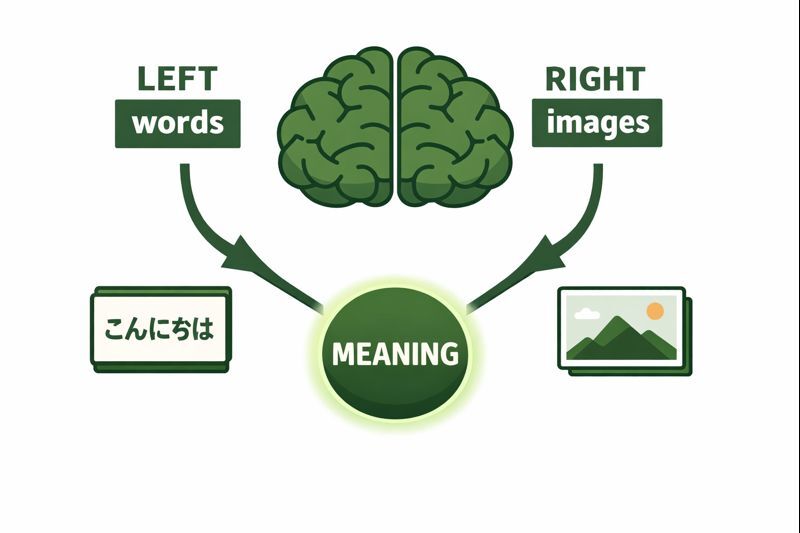
The Clarity Principle: same idea, clear connection.
Key part: same idea, clear connection. Images boost when they lock in what you're learning. They tank when they're ambiguous or decorative.
They shine with:
Concrete nouns
Like 猫 plus a cat pic = solid dual setup. The image nails down exactly what the word's aiming at.
Action verbs that you can picture clearly
Say 走る with someone running = clears up the motion.
Built-in mnemonics (think RTK or WaniKani)
For 休む = person (亻) leaning on a tree (木) → "resting against a tree."
This clicks because the image lives right in the kanji. You're training your eye to spot those bits inside—not tacking on some random shot. Studies back it: these kind of mnemonics cut down how many reps you need and stick better long-term.
Kanji mnemonics aren't the same as tossing in cute clipart. One helps you really see the parts; the other hands your brain generic visual noise it doesn't need.
Was this forwarded to you? Subscribe to Kotoba Brew—weekly systems for serious Japanese learners. Free, every Thursday.
Subscribe
What about abstract words?
This is where a lot of image tips go off the rails. Concrete stuff's straightforward. 犬 = dog. Grab a dog photo. Easy.
But try 自由—freedom? Or 努力—effort? 曖昧—ambiguity?
You can't just search "freedom" and snag something useful. That stock shot of arms-out-on-a-cliff? It doesn't teach squat. It's just... some person on a cliff. Your brain files it as "generic inspiration photo," not "freedom." Could be freedom, could be adventure, could be achievement—too vague.
So here's what we do instead—and what actually sticks.
For abstract words, we ditch the stock photos and connect them to something personal. A specific moment. A scene that made us feel the word. Something unambiguous.
Example: Learning 自由—freedom.
We don't grab a random "freedom" stock photo. We think: "Where have I felt this?" For us, it's that scene when Eren meets Armin in the Paths realm—where young Eren stands above the clouds in that vast, ethereal space, discussing freedom right before erasing Armin's memory, from Attack on Titan.
That scene powerfully captures 自由 because it's the moment Eren articulates his deepest understanding of freedom—even as he's trapped by fate. The visual of him standing above the clouds, in that limitless sky, crystallizes the concept in a way that's both visually striking and emotionally specific.
You could use a screenshot from that exact moment—young Eren in the cloudy Paths realm—as your anchor image. It's unambiguous (clearly represents freedom in the context of breaking boundaries and seeking what lies beyond), emotionally resonant, and personally meaningful if that scene hit you hard, like it did for us.
That would make a much stronger anchor than a generic "freedom" stock photo, because it connects to a specific emotional moment where the concept was deeply explored: "that exact feeling? That's 自由".
We screenshot that exact frame. Stick it on the card.

Now, seeing 自由 doesn't just trigger "freedom, yeah." We feel it. And crucially—that feeling is specific and unambiguous. It doesn't mean hope, or adventure, or achievement. It means 自由. Nothing else.
This is what we call Anchor Images—personal, emotionally specific connections that create crystal-clear pathways to abstract concepts.
And here's the thing: this isn't just something that works for us. It's backed by research.
Studies on vocabulary acquisition show that words anchored to personal, emotionally meaningful contexts are learned more effectively than words presented in diverse or neutral contexts. Another study found that "personal meaning helps anchor words into memory, making them easier to recall" and that personalization significantly improves vocabulary retention.
Why? Your brain doesn't store "freedom" as a picture. It stores it as an emotional memory—how freedom feels to you. When you connect 自由 to a moment that made you feel that exact emotion, you're wiring the word the way your brain naturally learns abstract concepts. That's way more powerful (and way more specific) than any generic stock photo.
The anchor doesn't need to be from anime. We pull from everywhere—
Scenes from anime or films—a spot where the word hits (in Japanese)
People that fit—a buddy, character, celeb who embodies the concept
Personal moments—stuff where you lived the word yourself
Tunes—a track that nails the feeling, turned into an image from there
Even scents or feels—sensory bits, flipped into a visual trigger
Bottom line: The link's gotta be specific and hit for you. Someone else's "ideal" image? If it's generic, nah. Yours—clear and personal—sticks.
If that pic could fit a bunch of similar words (freedom, hope, adventure, dreams), it's not pulling its weight. Specific image = specific meaning.
How to build an anchor image
Step 1: Hit an abstract word, stop. Think: "Where'd I feel this? What specific moment connects?"
Step 2: Got a scene, memory, whatever? Find an image from it. Screenshot, photo, anything concrete.
Step 3: Nothing? Try picturing it yourself. Eyes shut, see it in your world. That mental snap's your anchor—no need for a card pic.
Step 4: Still blank? Ditch the image. Go with sentences and minimal pairs instead. Better none than a vague, ambiguous one.
This eats up maybe 30 seconds a card. Feels draggy at first. But one solid, specific anchor trumps a pile of generic "inspiration" photos.
Why personal anchors work better for abstract words
Cognitive research shows abstract words aren't learned the same way concrete words are.
Concrete words like 犬 → learned through sensory experience (what dogs look/sound/feel like)
Abstract words like 自由 → learned through emotional experience (what freedom FEELS like to you)
That's why generic "freedom" stock photos don't stick. They show someone else's visual metaphor—and it's usually vague enough to mean ten different things. Your brain needs YOUR emotional memory to anchor the concept with clarity.
The neuroscience: When you pair abstract words with personally meaningful, emotionally evocative images, you activate both the amygdala (emotional processing) and hippocampus (memory formation). This dual activation creates stronger, more durable memory traces than neutral images. And crucially—it creates a specific, unambiguous connection.
This doesn't mean every abstract word needs a personal story. But when you CAN connect it to a real moment you've experienced—that memory becomes a retrieval cue that's both stronger AND clearer than any stock photo. It helps you remember the word by recalling a vivid moment when you experienced it: you improve your vocabulary retention and recall.
The Image Clarity Test
Before you commit to a card's image, hit it with these three:
1. Is this image specific and unambiguous?
Could this image only mean THIS word, or could it represent 3-4 different concepts? If you covered the word, would you know which one it is?
2. Does this reinforce the actual concept, or just the English translation?
Good: Pic that catches the vibe of 狭い—cramped, squished, awkward.
Bad: Some hallway that's "narrow" in English but misses the uncomfortable feeling.
3. Can you recall the concept in real Japanese contexts?
Book, conversation, anime—you don't have the card image there. But do you have the CONCEPT locked in? The image may have helped lock it (great!)—question is: did it create a clear connection, or a fuzzy one?
Renshuu Time 練習
This week, two tasks:
Task 1: Audit 10 flashcards with the Clarity Test
Pick 10 cards with images in your SRS. For each one, run the three-question test:
1. Is this image specific? (Could only mean this word?)
2. Does it capture the concept or just the English?
3. Is the concept clear even without the image present?
Mark: ✅ (clear, specific) or ⚠️ (ambiguous, needs rework)
Task 2: Create one anchor image
Find one abstract word in your deck (or add a new one). Instead of a generic image, connect it to something specific and personal—a scene, a memory, a feeling you've actually experienced. Make it unambiguous.
You'll know you did it when: You've identified at least 2-3 cards where the image is too vague/generic, and you've created one crystal-clear personal anchor image.
Finding cards that need work isn't failure—it's clarity. Most learners never check if their images are actually specific. You just did.
Quick question for you
Do you use images on your flashcards?
• Always (concrete + abstract)
• Sometimes (concrete words only)
• Personal anchors for abstracts only
• Rarely / never
• "Wait, I should be using SPECIFIC images?"
Hit reply and let us know. We're genuinely curious how people approach this—and your answer might shape a future issue.
Someone forwarded this to you? Good friends share good brews. Subscribe to get Kotoba Brew every Thursday.
Subscribeこれからも一緒に頑張りましょうね〜
— Kotoba Brew Editorial Desk